

Maine has 65 lighthouses. You cannot see them all in one trip unless you own a boat and quit your job. But you can drive the coast and hit 12 of the most iconic ones in about four days, and if you pick the right ones you get the whole range: the 1791 light George Washington commissioned, the first sunrise in the United States, the most photographed station in America, and a working offshore light that still guides shipping traffic today.
This is the drive, south to north, with real access info. Not every light is open to the public. Some you can only photograph from across a harbor. That is part of the appeal.
Maine Lighthouses by Region
Use these five coastal groups as a map-style index. Each region link jumps to the point where that stretch begins in the road trip; the lighthouse links open the site’s individual place guides, including a few worthwhile lights beyond the main 12.
- South Coast: Start with Nubble Light, then keep Goat Island Lighthouse in mind if the southern coast is its own trip rather than the first morning of a longer drive.
- Portland / Casco Bay: The tightest cluster on the route includes Portland Head Light, Spring Point Ledge Light, and Bug Light.
- Midcoast: Offshore Seguin Island Lighthouse, boat-access Burnt Island Lighthouse, and road-access Pemaquid Point Lighthouse show why this section needs more time than its mileage suggests.
- Penobscot Bay: Use Curtis Island Light, Owls Head Lighthouse, and Rockland Breakwater Lighthouse to organize the mainland side. Pumpkin Island Light adds an island-side option beyond the linear road-trip list.
- Down East: The final stretch links Acadia’s Bass Harbor Head Lighthouse with the eastern endpoint at West Quoddy Head Lighthouse.
| Lighthouse | Town | Year Built | Access | Best For |
|---|---|---|---|---|
| Nubble Light | York | 1879 | View only from Sohier Park | Sunset photos |
| Portland Head Light | Cape Elizabeth | 1791 | Grounds + museum | The canonical Maine light |
| Spring Point Ledge | South Portland | 1897 | Walk the breakwater | Offshore feel, easy access |
| Bug Light | South Portland | 1875 | Park and grounds | Urban skyline views |
| Seguin Island Light | Seguin Island | 1857 | Boat charter only | Remote island visit |
| Burnt Island Light | Boothbay Harbor | 1821 | Boat tour + grounds | Living history program |
| Pemaquid Point Light | Bristol | 1835 | Park, museum, grounds | Dramatic rock ledges |
| Marshall Point Light | St. George | 1832 | Walkway + museum | Forrest Gump bridge |
| Owls Head Light | Owls Head | 1825 | Park + grounds | Short trail, big view |
| Rockland Breakwater | Rockland | 1902 | 7/8-mile granite walk | Earned access |
| Bass Harbor Head | Tremont | 1858 | Trail to viewpoint | Acadia 's postcard light |
| West Quoddy Head | Lubec | 1808 | State park + museum | Easternmost point |
Planning the Route
The full drive from York to Lubec is about 350 miles of coastal road, plus detours. Google Maps will tell you 7 hours. In reality, with stops, photos, and actually seeing the lights, you need four days minimum. Five is more comfortable. Seven if you want to add a boat trip to Seguin or slow down in Acadia.
A reasonable breakdown:
- Day 1: York to Portland (Nubble, Portland Head, Spring Point, Bug Light)
- Day 2: Portland to Pemaquid (optional Seguin boat, Burnt Island, Pemaquid)
- Day 3: Pemaquid to Rockland (Marshall Point, Owls Head, Rockland Breakwater)
- Day 4: Rockland to Bar Harbor (Bass Harbor Head, time in Acadia)
- Day 5: Bar Harbor to Lubec (West Quoddy, drive home or keep going into Downeast)
1. Nubble Light (Cape Neddick)
Location: Sohier Park, York Beach | Built: 1879 | Still active: Yes
Nubble Light sits on a tiny rocky island about 100 yards off Cape Neddick. You cannot walk to it. You stand on the mainland at Sohier Park and look across. That gap, the little house of the keeper’s quarters with its red roof, and the surf breaking on the granite ledges is why this is arguably the most photographed lighthouse in the country. NASA actually included an image of Nubble on the Voyager spacecraft in 1977 as a representation of civilization on Earth.
Arrive at sunrise for golden light on the east-facing tower. In December the town wraps it in Christmas lights and people drive an hour just to see it.
Access: Free parking at Sohier Park, open year-round. Gift shop across the street.
2. Portland Head Light (Cape Elizabeth)
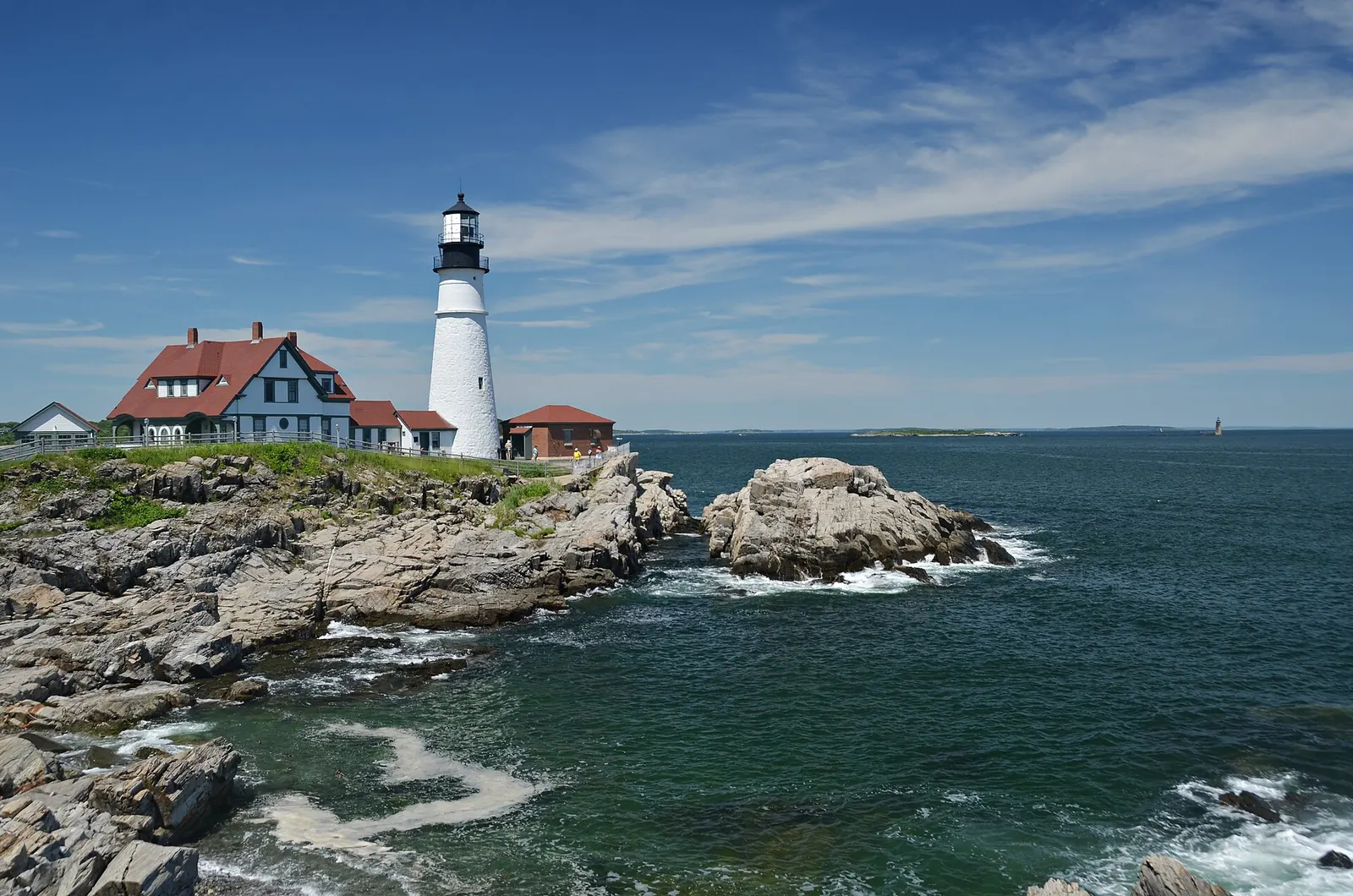
Location: Fort Williams Park, Cape Elizabeth | Built: 1791 | Still active: Yes
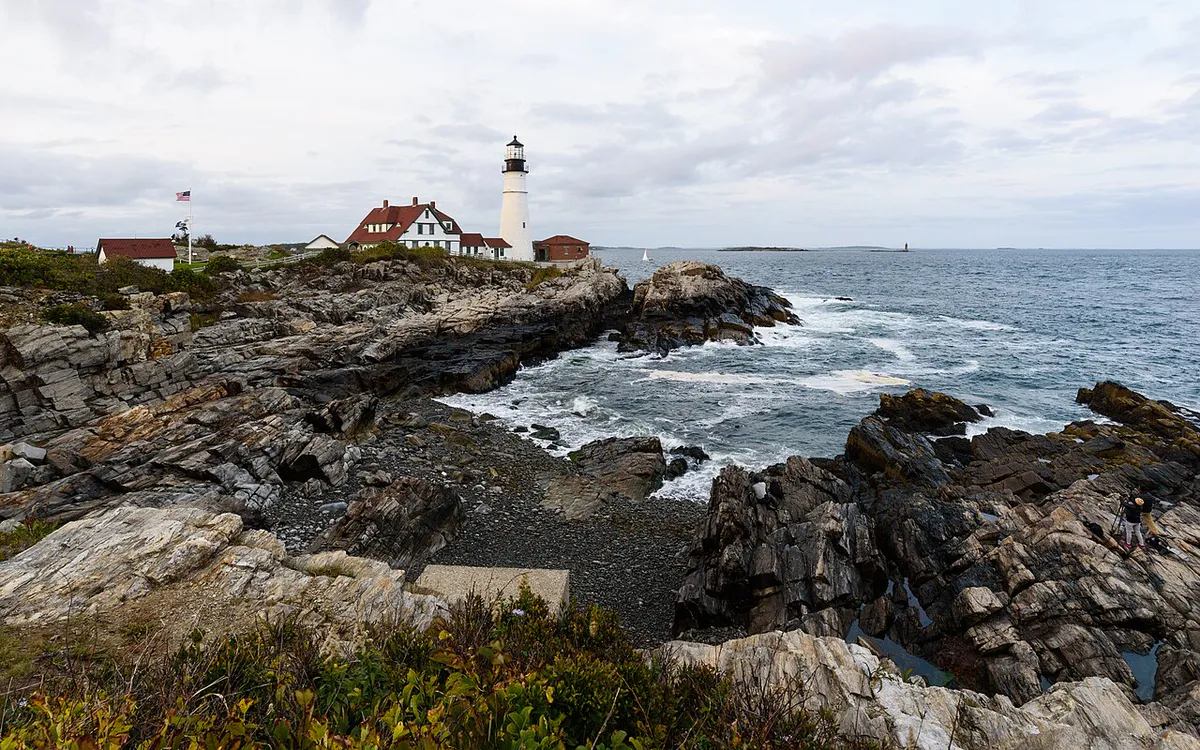
If you only visit one Maine lighthouse, make it Portland Head. George Washington commissioned it. Construction started in 1787. It is the oldest light in Maine and one of the oldest in the country.
The setting helps. Portland Head sits on a headland of dark, layered metamorphic rock that the surf hammers year-round. Behind the light, Fort Williams Park has 90 acres of walking paths, the ruins of Goddard Mansion, and enough picnic area to lose a crowd. The museum in the keeper’s quarters covers the light’s history and the 1886 wreck of the Annie C. Maguire, which ran aground on the rocks at the base of the tower on Christmas Eve.
Allow two hours. The best light is early morning (sun comes over the ocean behind the tower) or late afternoon (front-lit tower).
Access: Free entry to the park. Museum is $3. Open year-round; dawn to dusk.
3. Spring Point Ledge Light (South Portland)
Location: End of Fort Road, South Portland | Built: 1897 | Still active: Yes
Spring Point Ledge is a “sparkplug” lighthouse. Short, cylindrical, built on a caisson directly on the shoal it marks. What makes it special is access. In 1951 the US Army Corps of Engineers completed a granite breakwater connecting the light to shore. You can walk out 900 feet on massive granite blocks to the base of the tower. It is the only caisson light in Maine you can reach on foot.
The walk is not paved. The blocks are uneven and slippery when wet. Wear real shoes. In rough weather, stay off the breakwater. The surf comes over the rocks.
Access: Free parking at Southern Maine Community College. Breakwater open year-round; tower interior open seasonally.
4. Bug Light (Portland)
Location: Bug Light Park, South Portland | Built: 1875 | Still active: Yes
Officially Portland Breakwater Light. Everyone in Portland calls it Bug Light. It is small, ornate, modeled on an ancient Greek monument, and sits at the end of a short breakwater with the Portland skyline and working harbor behind it.
This is the urban lighthouse. You will see container ships, fishing boats, and tugs working the channel. The surrounding park is a former WWII shipyard where Liberty ships were built. There is a memorial on site.
Pair Bug Light with Spring Point. They are a 10-minute drive apart in South Portland.
Access: Free park with parking. Open year-round.
5. Seguin Island Light
Location: Seguin Island, 2 miles offshore from Popham Beach | Built: 1857 (current tower) | Still active: Yes
Seguin is not easy. It sits on a 180-foot island 2 miles off the mouth of the Kennebec River. There is no ferry. To get there you charter a boat or join a day tour operated by Friends of Seguin Island.
It is worth the effort. Seguin’s is the second-oldest commissioned lighthouse in Maine, the tallest light on the coast, and the only active first-order Fresnel lens lighthouse in the state. The 282-step walk from the landing to the light is steep. The view from the top includes Monhegan on clear days.
Access: Seasonal boat charters from Boothbay Harbor, Popham, or Bath. Book ahead. Weather cancels frequently.
6. Burnt Island Light (Boothbay Harbor)
Location: Burnt Island, Boothbay Harbor | Built: 1821 | Still active: Yes
One of the few lighthouses in the country where you can step back into the 1950s. Maine’s Department of Marine Resources runs a living history program on Burnt Island where costumed interpreters play the light keeper and his family in 1950. You take a boat over from Boothbay Harbor, spend about three hours on the island, and tour the tower, the keeper’s house, and the grounds in character.
Book the tour early. Slots fill by early summer.
Access: Tour only, via Balmy Days Cruises. Seasonal (late June through August).
7. Pemaquid Point Light (Bristol)
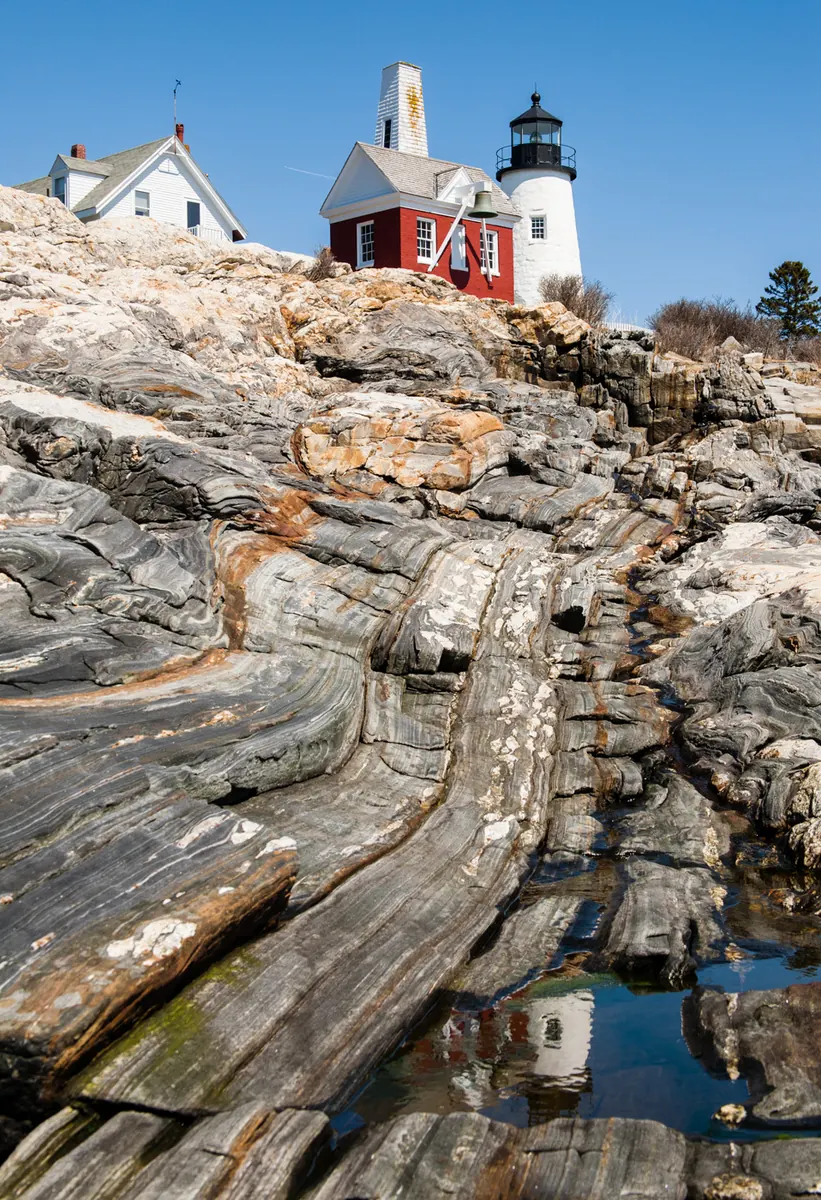
Location: Pemaquid Point, Bristol | Built: 1835 | Still active: Yes
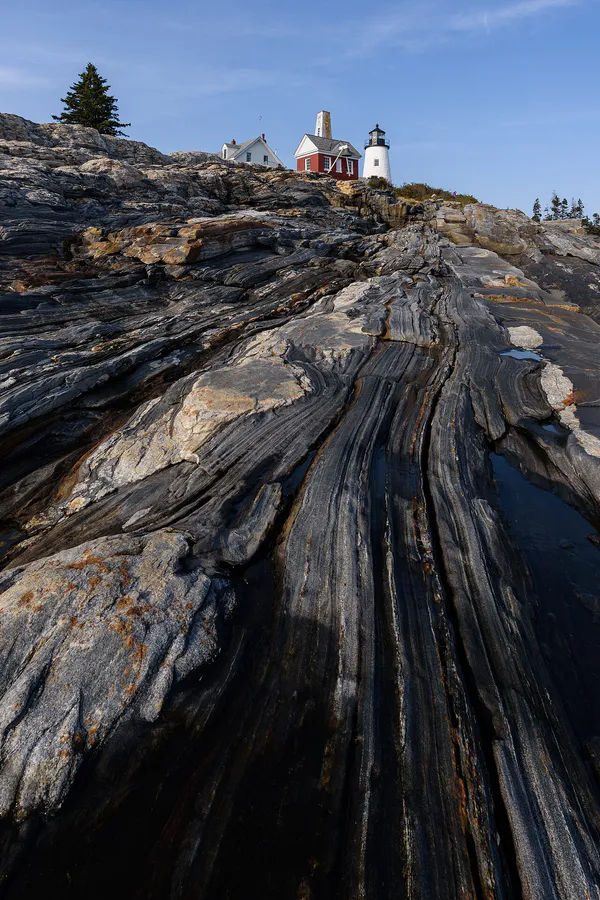
Pemaquid is on the back of the Maine state quarter. That tells you something about its place in the iconography. What the quarter does not show is what the ledges look like up close. They are bands of metamorphic rock folded and striated into patterns that look geological but feel almost hand-carved. You walk right out on them.
Do not walk out when the surf is up. People have died here. The signs are not decorative. The granite ledges get slick and the waves reach higher than you think.
The Fishermen’s Museum in the keeper’s quarters covers the working history of Midcoast fishing. Worth an hour. The light itself is open for tower climbs during the season.
Access: $3 park entry. Museum and tower open mid-May through mid-October.
8. Marshall Point Light (St. George)
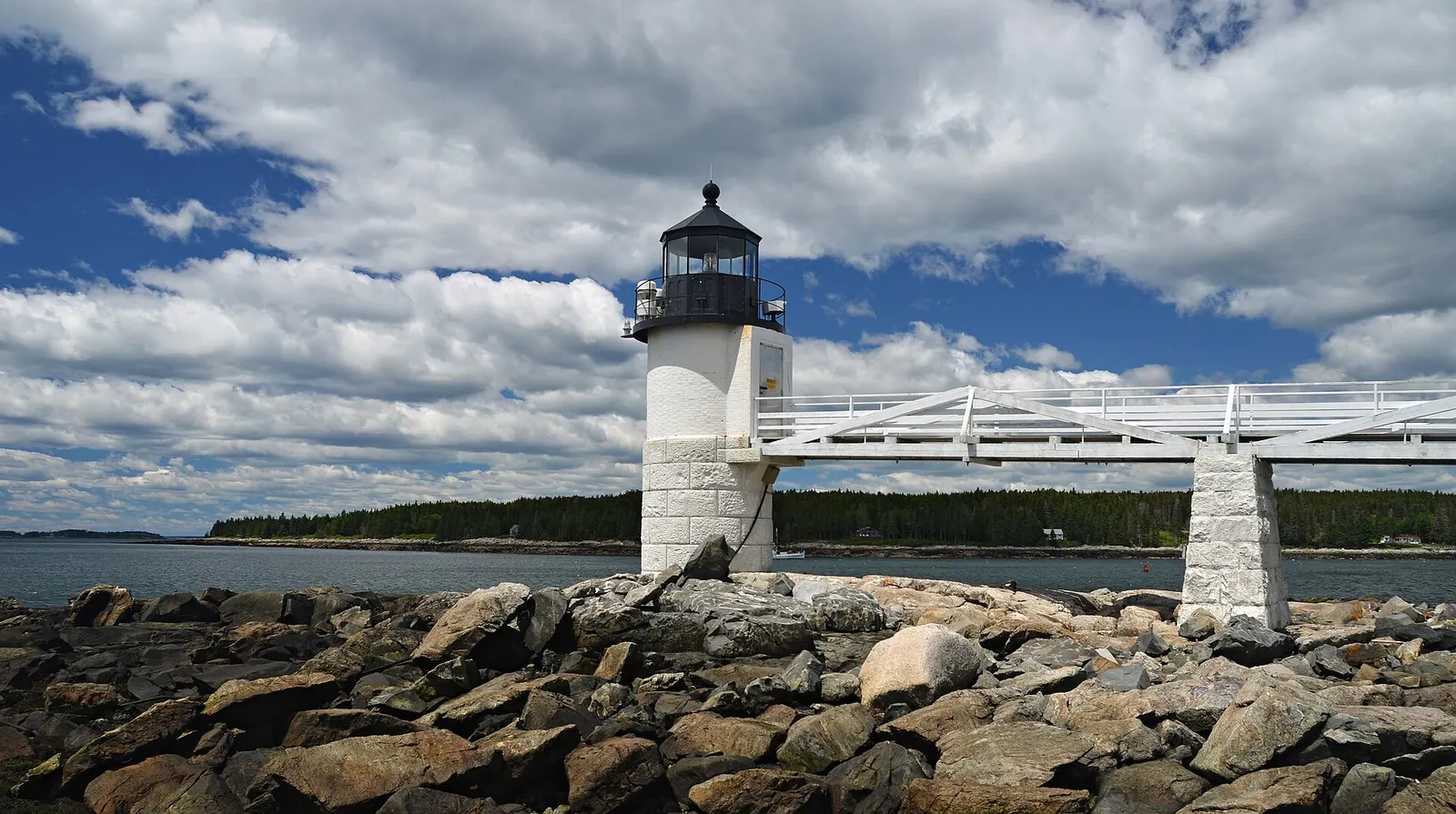
Location: Port Clyde, St. George | Built: 1832 | Still active: Yes
Marshall Point is the one from Forrest Gump. The short white walkway with a covered ramp where Forrest ended his cross-country run. It is a real place. The ramp is the same ramp. Tourists have been showing up to reenact the scene since 1994 and the town has made peace with it.
Beyond the movie, Marshall Point is a quiet working-harbor light. Port Clyde is a fishing village that also happens to be the home port for the Monhegan ferry. The Marshall Point museum in the keeper’s quarters is small but well curated. The grounds are a good spot for a picnic.
Access: Free parking. Grounds open year-round; museum seasonal.
9. Owls Head Light
Location: Owls Head Light State Park, Owls Head | Built: 1825 | Still active: Yes
Owls Head is a short squat tower on a bluff 100 feet above the water, reached by an easy tenth-of-a-mile trail through the woods. The walk matters. You come around a bend and the tower is suddenly there, with Penobscot Bay spread out below. It is the only lighthouse on this trip where the approach is part of the experience.
The Coast Guard opens the tower periodically. Check ahead. Otherwise you are here for the view and the walk.
Access: Free state park, open year-round. Park closes at sunset.
10. Rockland Breakwater Light
Location: End of the Rockland breakwater, Rockland | Built: 1902 | Still active: Yes
This is the lighthouse you earn. The Rockland Breakwater Light sits at the end of a granite breakwater 4,346 feet long. Almost a mile. The blocks are massive, irregular, and uneven. The walk takes 20 to 30 minutes each way. On a windy day waves break over the wall. On a calm day you pass lobstermen setting traps in the harbor.
The light itself is small and pretty. The walk is the point. Do not attempt in ice or high surf.
Access: Free parking at Marie Reed Park. Breakwater open year-round in walkable conditions.
Pair the Rockland Breakwater walk with lunch in downtown Rockland and a visit to the Farnsworth Art Museum. Rockland punches well above its population for food, art, and bookstores. Budget the whole day.
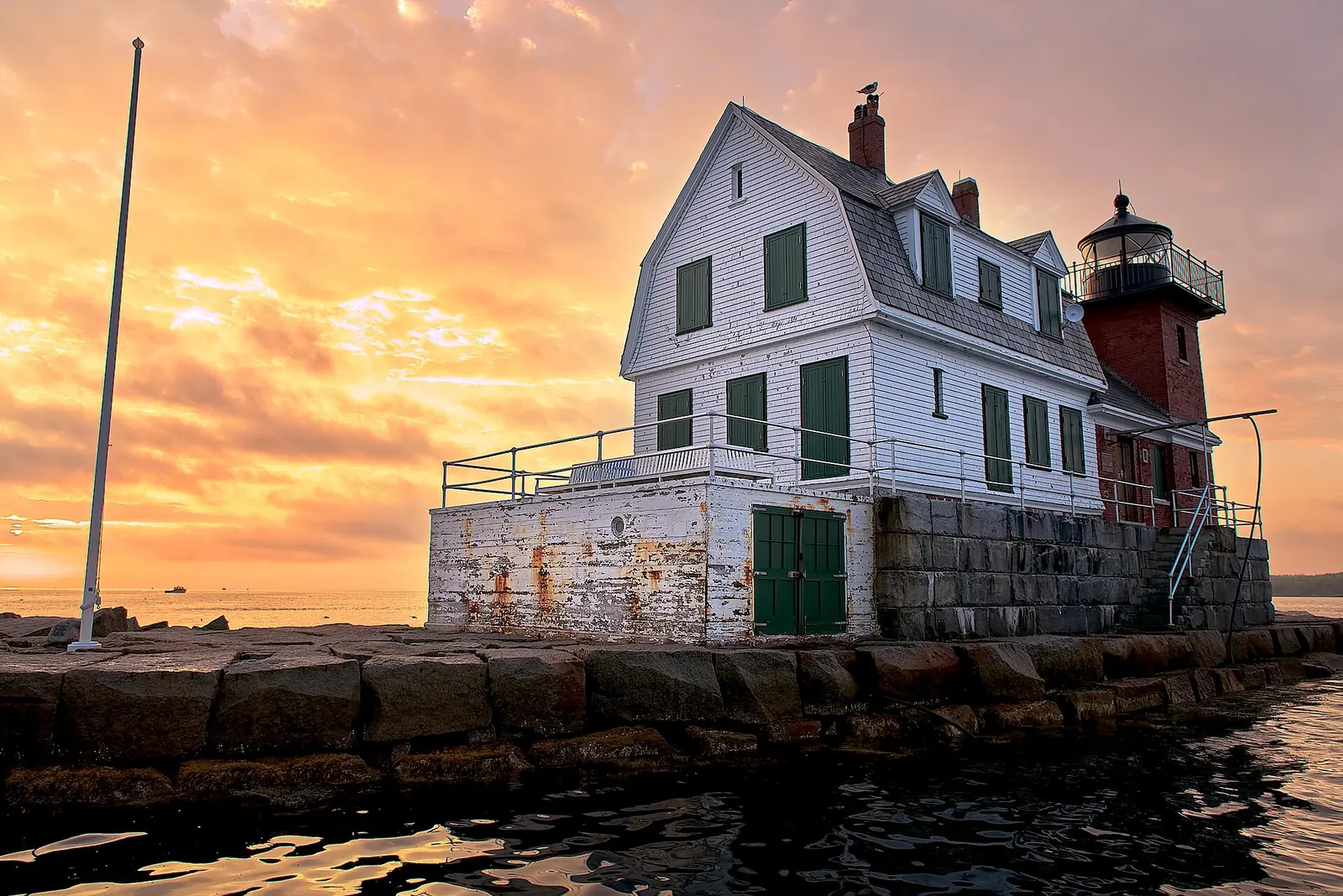
11. Bass Harbor Head Light (Acadia)
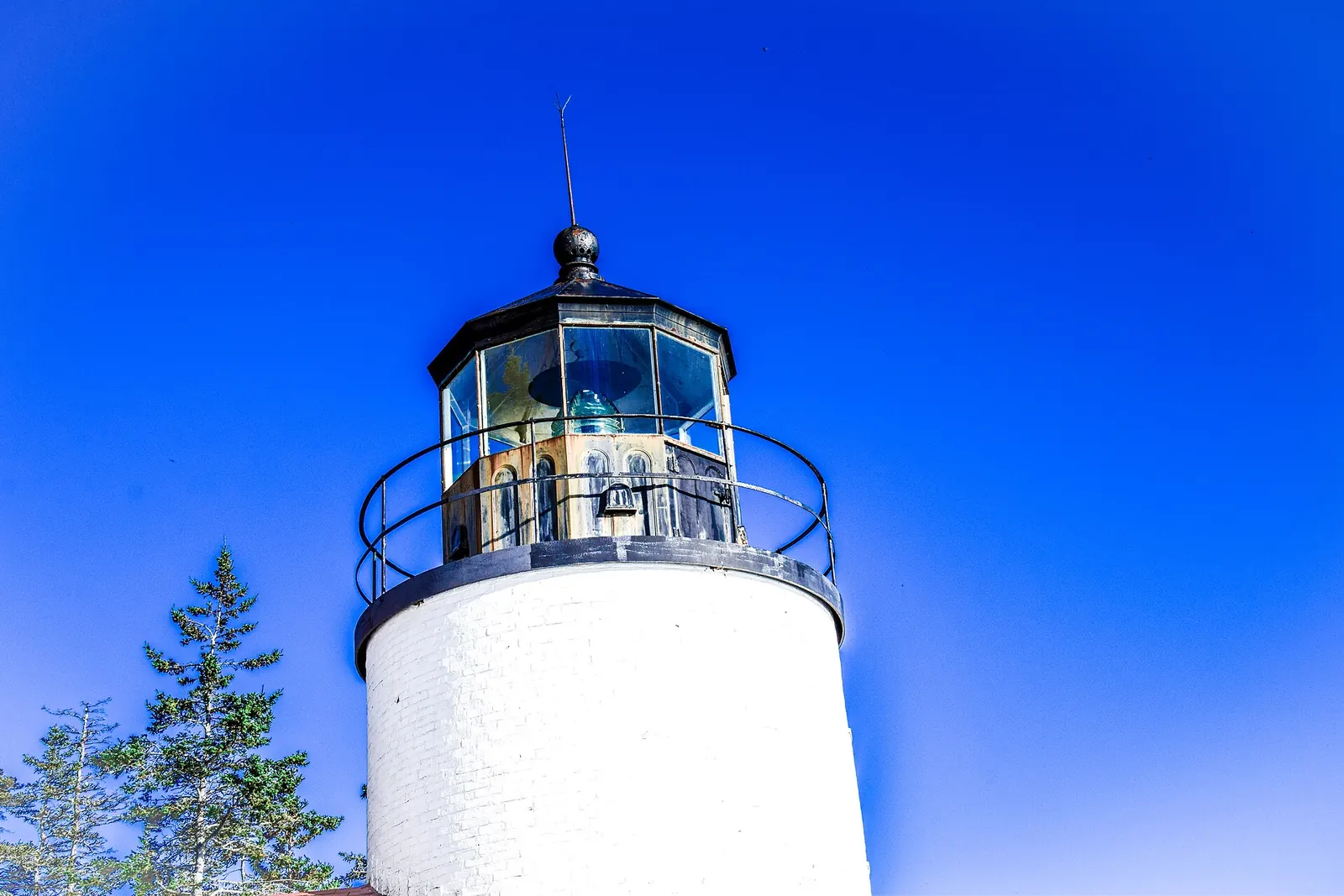
Location: Tremont, Mount Desert Island | Built: 1858 | Still active: Yes
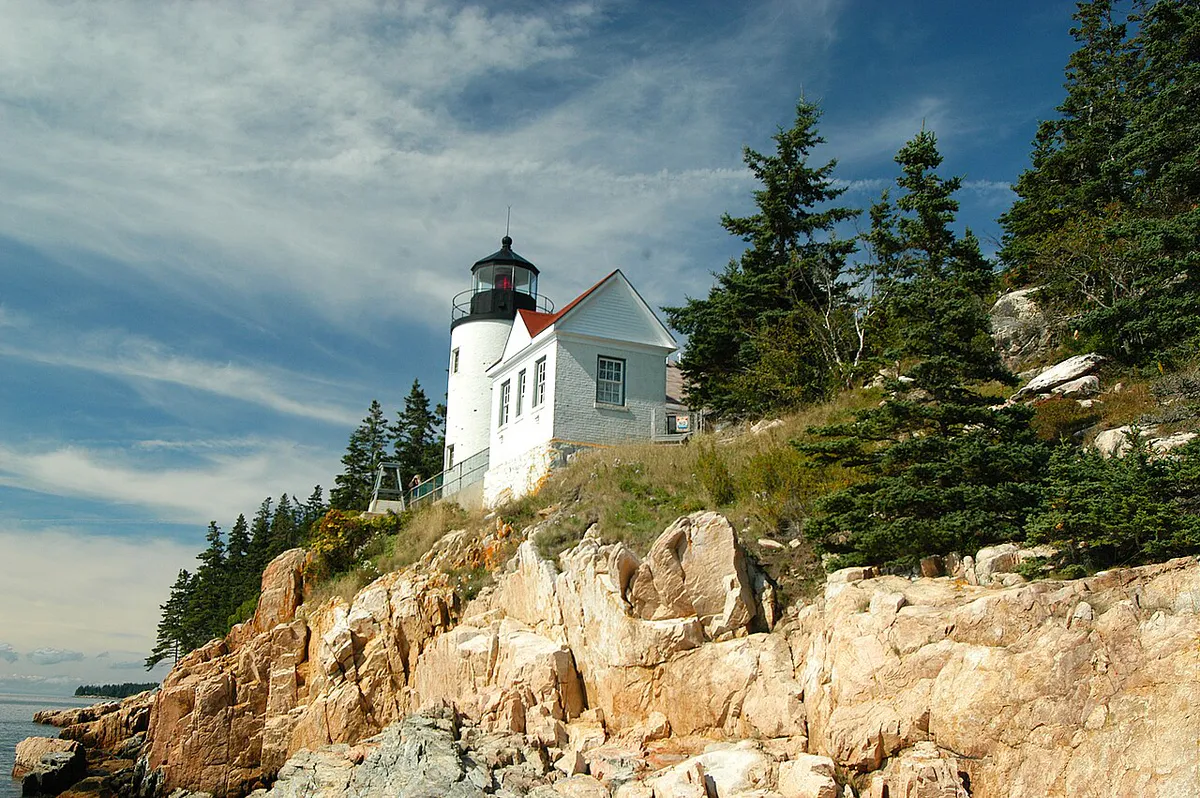
Bass Harbor Head sits on Acadia’s quiet side, the western half of Mount Desert Island. A short trail through the woods brings you to a set of stairs that drop down to a viewing platform on the cliffs below the tower. The view up at the light from those rocks, with the pink granite ledges and the open Atlantic, is what makes this one of the most photographed lights on the coast.
Parking is a problem. The small lot fills by mid-morning in summer. Go at sunrise or in the off-season. The Island Explorer shuttle does not currently serve this light.
Access: Free, but you need an Acadia park pass for other park sites. Trail open year-round.
12. West Quoddy Head Light (Lubec)
Location: Quoddy Head State Park, Lubec | Built: 1808 (current tower 1858) | Still active: Yes
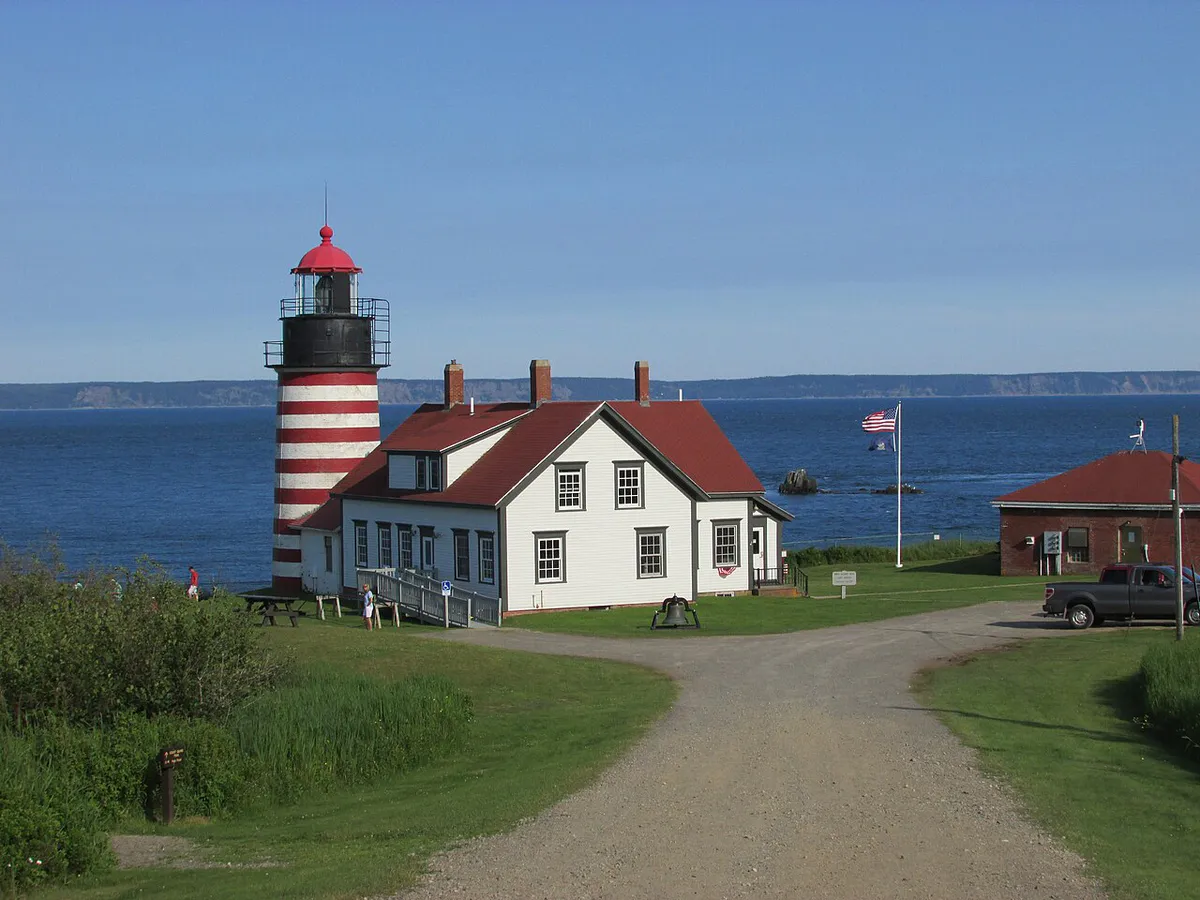
The candy cane. The easternmost point in the continental United States. West Quoddy Head is a red-and-white striped tower (Maine’s only striped light) on the tip of a headland in Quoddy Head State Park. The first sunrise in the country hits here. There is a stone marker, a visitor center with exhibits on the Fresnel lens and local shipwrecks, and about four miles of coastal trail through the spruce-fir forest along 90-foot cliffs.
Lubec is a 6-hour drive from Portland. You are making a commitment to get here. The reward is the end of the map: the last light, the coldest ocean, and a fishing village with fog that rolls in so thick it feels like a wall.
Access: $4 non-resident, $3 Maine resident adult, $1 children 5-11. Open mid-May through mid-October. Off-season access is on foot.
Lubec is a small town but it has a few excellent restaurants and a couple of good inns. Plan to stay the night. Drive back to the light at sunrise. You will have it to yourself, and watching the first light of the day hit the Atlantic from the easternmost point of the country is worth the early alarm.
Best Season
Late May through mid-October is the main season. Most museums and tower climbs are only open during these months. Weather is best from mid-June through September.
Autumn (late September through mid-October) is arguably the best time to photograph lights. The air is clearer, the crowds thin, and the light is golden earlier in the day. Many lights that sit on dramatic rock coasts stand out against spruce-fir backdrops just starting to turn.
Winter is for the committed. Many lights are closed or only viewable from outside. The coastal storms can be dramatic. Dress for it and check forecasts. The drive on Route 1 is plowed and passable but side roads to some lights may not be.
Photography Tips
- Portland Head is best at sunrise or sunset, not midday. The tower sits on a headland that faces south-east.
- Nubble faces east. Sunrise is the move. Bring a telephoto (200mm or longer) to compress the gap and fill the frame.
- West Quoddy faces east. Sunrise wins again.
- Bass Harbor Head is a sunset light. The tower faces south-west and catches the golden hour directly.
- Pemaquid works any time but the dramatic ledges photograph best in side light (early or late).
- For moody shots, shoot in fog. Maine fog is frequent, especially Downeast. A foghorn light in fog is a different kind of image entirely.
Respect the safety barriers. Every year someone gets swept off a ledge trying to get a shot. The surf in Maine is cold enough that survival time is counted in minutes.
Accessibility Notes
- Portland Head, Bug Light, Owls Head, and West Quoddy Head have paved parking close to viewing areas.
- Spring Point Ledge and Rockland Breakwater require walking on uneven granite; not wheelchair accessible.
- Burnt Island and Seguin require climbing off a small boat onto a dock or beach.
- Nubble is view-only from the mainland park, which is accessible.
- Bass Harbor Head requires some stair descent for the cliff-level viewpoint, but the upper viewpoint is reachable on a short flat path.
Where to Stay
Good basing points along the route:
- York/Ogunquit: For Nubble and the southern coast.
- Portland / Kennebunkport: For Portland Head, Spring Point, and Bug Light. Portland is the most food-oriented stop on the drive.
- Boothbay Harbor / Damariscotta: For Burnt Island, Pemaquid, and Seguin trips.
- Camden / Rockland: For Marshall Point, Owls Head, and Rockland Breakwater. Arts towns with strong restaurants.
- Bar Harbor: For Bass Harbor Head and Acadia.
- Lubec: For West Quoddy. Last town before Canada.
How many days do I need for a Maine lighthouse road trip?
Four days at minimum if you drive from York to Lubec and want real time at each light. Five is comfortable. Seven if you want to add a boat trip to Seguin or Burnt Island and time in Acadia. Trying to do it in a long weekend means fast stops and no museum visits.
What is the most famous lighthouse in Maine?
Portland Head Light in Cape Elizabeth. Commissioned by George Washington and first lit in 1791, it's the oldest lighthouse in Maine and one of the most recognizable on the Atlantic coast. Nubble Light in York is probably the most photographed.
Can you go inside Maine lighthouses?
Some of them. Portland Head, Pemaquid Point, Spring Point Ledge, and West Quoddy Head have seasonal tower or museum access. Others like Nubble and Bass Harbor Head are view-only. Burnt Island requires a guided tour. Seguin requires a boat charter.
What is the easternmost lighthouse in the United States?
West Quoddy Head Light in Lubec, Maine. Located in Quoddy Head State Park, it marks the easternmost point of the continental United States and is the only red-and-white striped lighthouse in Maine.
When is the best time to visit Maine lighthouses?
Late May through mid-October is the main season, when museums and tower climbs are open. Late September to mid-October offers the best combination of fall foliage, clear air, thin crowds, and golden light for photography. Winter visits are possible but most interior access is closed.
Are there free Maine lighthouses to visit?
Yes. Nubble Light, Portland Head grounds (Fort Williams Park), Bug Light, Owls Head Light, Rockland Breakwater, and Marshall Point are all free to access. Some state parks charge a small day-use fee ($2-$3) for entry but the grounds themselves are open.