




A Waterfall in the Middle of Town
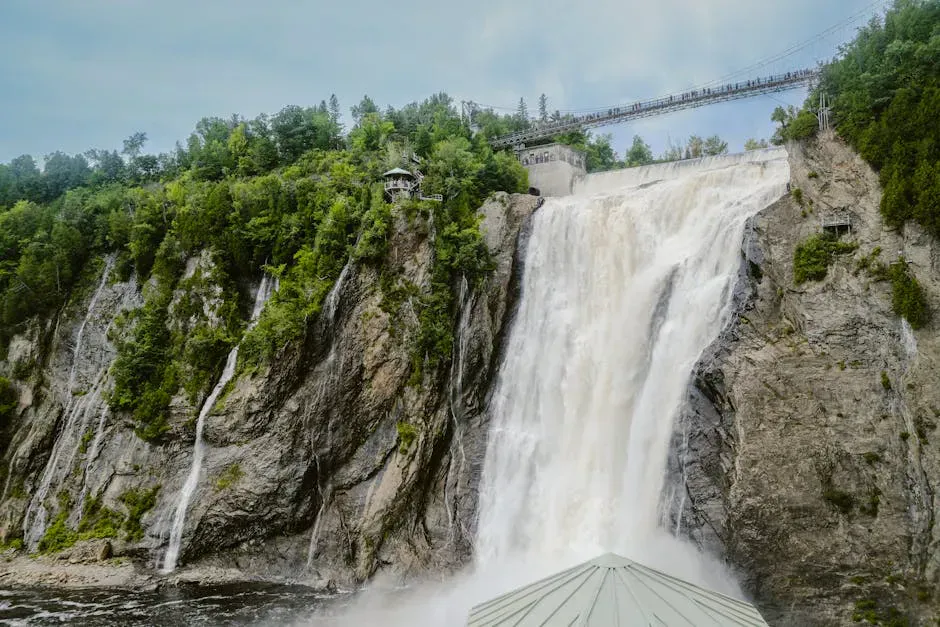
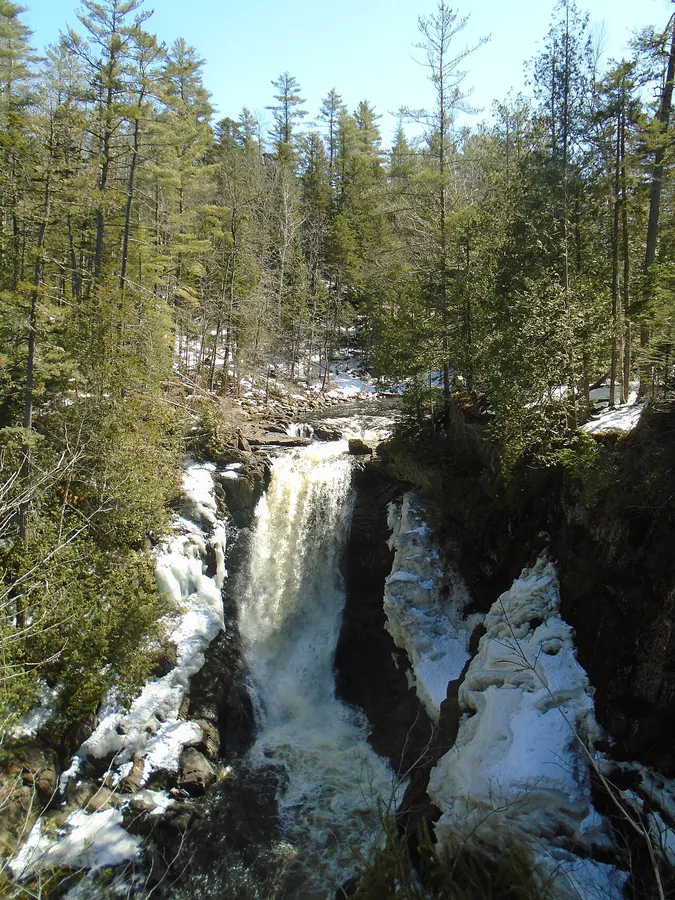
Rumford Falls is not hidden in the backcountry. It is right in the center of Rumford, Maine, surrounded by brick mill buildings and the infrastructure of a working paper town. The Androscoggin River drops 176 feet through a series of cascades and chutes as it cuts through a granite gorge in the middle of the downtown, including one steep chute that drops about 65 feet in a run of roughly 250 linear feet. Before dams and powerhouses harnessed the flow, this was likely the most powerful waterfall in New England.
Today, a hydroelectric dam diverts much of the river’s volume into a powerhouse upstream of the main falls. The power station and associated dams at Rumford Falls have been in operation since 1918. The falls still run, and during high water in spring they are dramatic, but you are seeing a managed version of what was once an enormous natural spectacle. Even so, the scale of the gorge, the roar of the water, and the setting make this one of the more unusual waterfalls in Maine.
The gorge walls are steep, and the rocks near the water are slippery year-round. The viewing platforms have railings for a reason. Do not climb down toward the river. The current below the dam is unpredictable, and dam releases can change water levels without warning. People have been injured here.
The Viewing Area
The best views of Rumford Falls come from J. Eugene Boivin Park, located at the junction of Route 2 and Route 108 in downtown Rumford. A small visitor center sits nearby, and a short loop trail (about half a mile) follows sidewalks and gravel paths along the gorge rim, providing several overlooks of the cascades, the old dam structures, and the river below. At the foot of the falls, a reflection pool offers a peaceful spot for relaxation.
The trail is flat and accessible. You do not need hiking boots or any special gear. The entire loop takes about 20 to 30 minutes at a casual pace, including stops at the viewing platforms. Interpretive signs along the route explain the history of the mills and the hydroelectric operation.
The falls face roughly west, so afternoon light hits the water nicely. Morning visits can feel shadowed by the mill buildings on the east bank. A pair of compact binoculars helps you pick out detail in the cascades and the old dam structures across the gorge from the overlooks.
The best time to see Rumford Falls at anything close to its natural power is during spring runoff in April and May. Snowmelt from the western mountains pushes the Androscoggin to high volume, and the dam releases more water than usual. The difference between spring flow and late summer is enormous. If you can time your visit for a high-water day, the falls will give you a sense of the raw power this river once unleashed year-round.
History and the Mills
Rumford Falls powered one of the largest paper mills in the world. Hugh Chisholm, a Canadian-born industrialist, arrived in the 1890s and built the Oxford Paper Company around the energy potential of these falls. At its peak, the mill complex employed thousands and made Rumford a company town in every sense.
The mills are still operating in reduced form. You can see the massive brick buildings from the viewing platforms, and the hum of machinery is part of the soundtrack. The combination of raw natural power and industrial history gives Rumford Falls a character that purely wild waterfalls do not have. This is a place where humans bent a river to their purposes, and the river is still pushing back.
The town of Rumford itself is a working-class community with a straightforward charm. It is not a tourist destination in the conventional sense, which means you will often have the viewing platforms to yourself.
Rumford has a surprisingly good food scene for a small mill town. Check out the local restaurants on Congress Street for comfort food. The town is also a good base for exploring Coos Canyon and Swift River Falls, both within a short drive on Route 17 north.
When to Go
Spring
Highest water flow from snowmelt. The falls are at their most powerful in April and May when the dam releases more water.
Summer
Lower water flow but pleasant weather. Easy to combine with other Oxford County stops.
Fall
Moderate flow. Fall foliage along the river gorge adds color to the scene.
Winter
The falls run year-round. Ice formations on the gorge walls can be impressive. Dress warmly for the wind.
Spring is the clear winner for seeing Rumford Falls at full force. By late summer, the dam diverts enough water that the cascade thins noticeably. Fall foliage adds color to the gorge, and the contrast of orange maples against dark granite and white water photographs well. Winter visits are possible and the ice buildup on the gorge walls can be striking, though the wind through the river valley is cold.
Getting There
Rumford is at the intersection of Route 2 and Route 108 in Oxford County, about two hours northwest of Portland and two and a half hours from Bangor. The viewing area at J. Eugene Boivin Park is right downtown. There is free parking near the visitor center.
From Bethel, head east on Route 2 for about 25 miles. From Auburn/Lewiston, take Route 108 north for approximately 45 miles.
GPS coordinates: 44.5519, -70.5442
Packing List
Rumford Falls Visit
- Camera (afternoon light is best on the falls)
- Water bottle
- Comfortable shoes (sidewalks and gravel paths)
- Windbreaker (the gorge channels wind off the river)
- Binoculars (to see detail in the cascades from the overlooks)
FAQ
How tall is Rumford Falls?
The Androscoggin River drops a total of 176 feet through the cascade system at Rumford. The main visible section includes a steep chute dropping about 65 feet in a run of roughly 250 linear feet, with additional drops above and below.
Can you swim at Rumford Falls?
No. Swimming is not safe or permitted in the gorge below the falls. The current is strong, the rocks are slippery, and dam releases can change water levels without warning.
Is there a trail at Rumford Falls?
Yes. A short loop trail of about half a mile follows the gorge rim from J. Eugene Boivin Park, with several viewing platforms. The path is flat, mostly paved or gravel, and accessible for all ability levels.
Is Rumford Falls a natural waterfall?
The falls are natural in origin, but a hydroelectric dam upstream has diverted much of the river's flow into a powerhouse since 1918. The cascade you see today is real but reduced from its original volume. During spring runoff, the dam releases more water and the falls are significantly more powerful.
When is the best time to visit Rumford Falls?
Spring (April and May) offers the highest water flow and the most dramatic display. Summer and fall are pleasant for walking the trail. The falls run year-round, so winter visits are possible if you dress for cold weather.