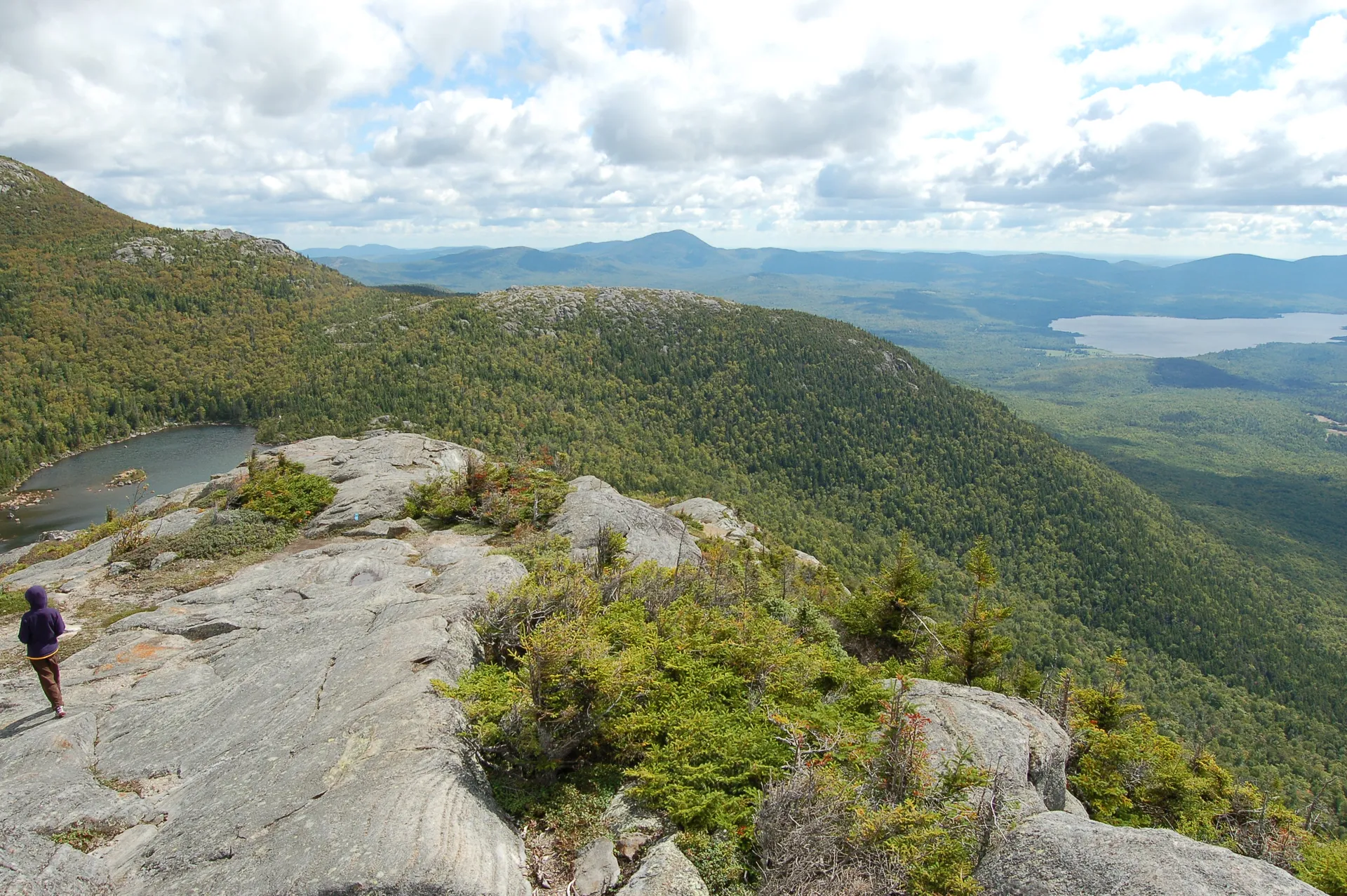



The wind on a Maine summit does not care what the forecast said in the parking lot. You can leave a trailhead at Tumbledown in shorts on a warm June morning, climb through spruce, and step onto the open ledges into a 25 mph wind that drops the felt temperature 20 degrees in a hundred yards. The same thing happens on Cadillac when a marine layer rolls in off the water and the granite goes from sun-warm to raw in minutes. An insulated jacket stuffed in the lid of your pack is the difference between turning around and finishing the ridge.
Maine adds a complication most jacket reviews skip: it is wet. Coastal fog, shoulder-season drizzle, and wet winter snow all soak insulation, and that is where the down-versus-synthetic question stops being academic. Down is warmer and packs smaller, but it collapses when it gets wet and stops insulating. Synthetic fill is heavier and bulkier, but it keeps working damp. On a clear winter day in Baxter State Park down is the obvious call. On a foggy evening by the coast or a wet March hike, synthetic earns its weight.
We picked seven jackets that cover the realistic situations Maine throws at you: a midweight you can layer all winter, an ultralight for fast summit days, synthetic options for wet conditions, and a budget down jacket that does most of what the expensive ones do. The picks below sort out which is which.
| Jacket | Price | Insulation | Weight | Rating |
|---|---|---|---|---|
| Premium | 800-fill down | 13 oz | 4.7 | |
| Arc'teryx Cerium Hoody | Premium | 850-fill down | 11 oz | 4.8 |
| Patagonia Nano Puff Hoody | Mid-range | PrimaLoft synthetic | 13 oz | 4.6 |
| Mountain Hardwear Ghost Whisperer/2 | Premium | 800-fill down | 9 oz | 4.5 |
| REI Co-op 650 Down 2.0Search REI | Budget | 650-fill down | 14 oz | 4.5 |
| Rab Microlight Alpine | Mid-range | 700-fill down | 15 oz | 4.7 |
| The North Face ThermoBall Eco | Mid-range | ThermoBall synthetic | 15 oz | 4.4 |
How We Chose
We weighed four things, in this order: warmth for the weight, how each jacket handles moisture, packability, and shell durability. Maine makes the second one matter more than it does in drier mountains. A jacket that is toasty in a Colorado deep freeze can leave you cold and miserable in Maine coastal fog if it is stuffed with untreated down.
Warmth-to-weight is mostly a down story. Fill power (the 650, 700, 800, and 850 numbers) measures how much loft an ounce of down produces, and higher numbers mean more warmth for less weight. An 850-fill jacket like the Cerium is warmer and lighter than a 650-fill jacket with the same amount of down. Synthetic fill does not use fill power the same way, so we judged the Nano Puff and ThermoBall on real-world warmth and how they held up damp.
Moisture handling is the Maine filter. We favored synthetic insulation and hydrophobic (water-treated) down for anyone hiking the coast, the shoulder seasons, or anywhere wet snow is likely. For cold, dry winter use, untreated high-fill down is still the warmest and lightest answer.
Packability and shell durability are the last two, and they trade off against each other. The lightest jackets use thin shells that pack tiny but tear on granite and brush. We noted which jackets can take everyday abuse and which need babying.

The Jackets We Recommend
Patagonia Down Sweater, Best All-Around
Premium
Patagonia Down Sweater
Who it’s forBest all-around insulated jacket for Maine three-season use
Why we picked it800-fill recycled down packs serious warmth into 13 oz
Pros
- Tough recycled ripstop shell handles brush and granite better than ultralight puffies
- Packs into its own chest pocket for stuffing in a daypack
Know before you buy
- Down loses loft if it gets soaked on a wet coastal hike
- Premium price for what is a midweight, not a winter parka
Sold direct by the brand, not on Amazon.
The Down Sweater is the jacket we reach for most three seasons of the year in Maine. 800-fill recycled down delivers real warmth in a 13-ounce package, enough to stand comfortably on a windy Cadillac summit in fall or throw on at a cold camp in Baxter. It hits the sweet spot between warmth and weight without going so ultralight that the shell falls apart.
What sets it apart from lighter puffies is the shell. The recycled ripstop is noticeably tougher than the 10-denier fabric on the Ghost Whisperer, which means you can wear it bushwhacking, lean against granite, and toss it in a pack without obsessing over snags. It still packs into its own chest pocket, so it disappears into a daypack when the sun comes back out.
The honest limit is the same as any down jacket: get it soaked on a wet coastal hike and the down clumps and stops insulating. For dry-cold conditions it is excellent. For consistently damp days, we would point you to the Nano Puff or the hydrophobic-down Rab instead.
Arc’teryx Cerium Hoody, Best Warmth-to-Weight
Premium
Arc'teryx Cerium Hoody
Who it’s forBest warmth-to-weight down jacket for summits and winter layering
Why we picked it850-fill down with the best warmth-to-weight of anything here
Pros
- Synthetic Coreloft panels at the cuffs and shoulders where moisture collects
- Trim alpine cut layers cleanly under a hardshell
Know before you buy
- The most expensive jacket on this list
- Slim fit leaves little room for thick midlayers underneath
The Cerium is the warmest jacket here for its weight, and it is the one we would layer under a hardshell for winter summits. 850-fill down is the highest fill power on this list, which means it lofts more and traps more heat per ounce than anything else. At around 11 ounces it is barely heavier than the ultralight Ghost Whisperer but noticeably warmer.
The smart detail is where Arc’teryx put synthetic Coreloft instead of down: the cuffs, shoulders, and hood, exactly the spots that get wet first from pack straps, snow, and sweat. Down in those areas would collapse and chill you. The hybrid build keeps the jacket working in the damp spots while using down everywhere it stays dry. For Maine’s wet-cold winters that is a genuinely useful design, not a marketing line.
The cut is trim and alpine, which is great under a shell and tight if you want to stack a thick fleece underneath. It is also the most expensive jacket on this list. If you do serious winter hiking or want one do-everything cold-weather layer and the price is workable, this is the one we would buy.
Patagonia Nano Puff Hoody, Best Synthetic for Wet Conditions
Mid-range
Patagonia Nano Puff Hoody
Who it’s forBest synthetic jacket for damp coastal and shoulder-season conditions
Why we picked itPrimaLoft Gold synthetic keeps warming even when wet
Pros
- Wind- and water-resistant shell shrugs off coastal drizzle
- Compresses small and survives years of hard use
Know before you buy
- Less warm for its weight than down
- Thinner insulation than a true winter puffy
Sold direct by the brand, not on Amazon.
The Nano Puff is our pick for the conditions that ruin down. PrimaLoft Gold synthetic insulation keeps warming you even when it is soaked, which is the whole point on a foggy evening on the coast or a drizzly shoulder-season hike where you cannot keep a jacket dry. Where a down jacket would go flat and cold, the Nano Puff shrugs it off and keeps its loft.
The wind- and water-resistant shell is the other half of the Maine story. A steady marine drizzle beads up and rolls off long enough to keep you comfortable, and the synthetic fill underneath does not care if some moisture gets through. It compresses small, packs into its own pocket, and is famously durable. Plenty of people are still wearing Nano Puffs they bought a decade ago.
The trade-off is warmth. Synthetic fill is not as warm for its weight as down, so the Nano Puff is a midweight insulator, not a deep-winter parka. For a damp coastal walk, a paddle, or layering on a wet hike, that is exactly right. For a sub-zero summit you would want the Cerium.
Mountain Hardwear Ghost Whisperer/2, Best Ultralight
Premium
Mountain Hardwear Ghost Whisperer/2 Hoody
Who it’s forBest ultralight down jacket for fast summit days
Why we picked it800-fill down in a sub-9 oz package, the lightest jacket here
Pros
- Disappears into a pack lid for fast-and-light summit pushes
- Surprisingly warm for how little it weighs
Know before you buy
- Ultralight 10-denier shell snags and tears on rough granite
- Not built for everyday abuse or bushwhacking
The Ghost Whisperer is the jacket you carry when you almost did not want to carry a jacket. At under 9 ounces it is the lightest on this list, and the 800-fill down packs down to roughly the size of a water bottle. For a fast summer push up Katahdin or a long day in the 100-Mile Wilderness where you want insurance against a cold ridge but do not expect to wear it much, it is hard to beat.
The warmth-for-weight is genuinely surprising. Pull it on at a windy lunch spot and it punches well above what 9 ounces should deliver. As an emergency layer that lives permanently in the pack lid, the weight is so low there is no reason to leave it home.
The catch is the shell. The 10-denier ripstop is whisper-thin, which is how the jacket gets so light, and it snags and tears on granite, spruce branches, and rough pack abuse. This is not a jacket for bushwhacking or for leaning against rock ledges. Treat it as a careful-use ultralight piece and it shines. Want something you can abuse, get the Down Sweater.
REI Co-op 650 Down Jacket 2.0, Best Budget
Budget
REI Co-op 650 Down Jacket 2.0
Who it’s forBest budget down jacket for Maine
Why we picked itReal down warmth at a fraction of the premium price
Pros
- 650-fill recycled down is plenty for camp and casual hikes
- Two zippered hand pockets and a durable everyday shell
Know before you buy
- 650-fill is bulkier and heavier than 800-plus options
- Lower-fill down still collapses if it gets wet
Sold direct by the brand, not on Amazon.
The 650 Down 2.0 is proof you do not need to spend premium money for real down warmth. The 650-fill recycled down is lower fill power than the 800-plus jackets above, which means it is a little heavier and bulkier for the same warmth, but it still keeps you genuinely comfortable at camp, on cool-weather hikes, and around town through a Maine fall. For most people who want a down jacket without a premium price, this does the job.
The build is everyday-friendly. The shell is more durable than the ultralight puffies, the two zippered hand pockets are warm and practical, and the fit leaves room for a layer underneath. It is the jacket we would hand someone getting into hiking who is not ready to spend on a Cerium and may not need to.
Where you feel the price is packed size and the down itself. It stuffs bigger than the 800-fill jackets, and like all untreated down it collapses if it gets wet. For dry-cold Maine days it is a lot of warmth for the money. For wet conditions, step over to a synthetic option.
Rab Microlight Alpine, Best for Damp Maine Summits
Mid-range
Rab Microlight Alpine Jacket
Who it’s forBest down jacket for damp Maine summits and shoulder season
Why we picked it700-fill hydrophobic down resists moisture better than untreated down
Pros
- Helmet-compatible hood and stitched-through baffles hold heat at the core
- Tougher Pertex shell than most jackets in its weight class
Know before you buy
- Heavier than the ultralight puffies at around 15 oz
- Hydrophobic treatment slows wetting but does not make down waterproof
The Microlight Alpine is our pick when you want down warmth but expect moisture, which in Maine is most of the year. The 700-fill down is hydrophobic, meaning it is treated to resist wetting and dry faster than untreated down. On a foggy Tumbledown summit or a damp shoulder-season hike, that treatment buys you real time before the loft starts to suffer.
The build is aimed at exactly this use. The helmet-compatible hood seals heat in, the stitched-through baffles concentrate warmth at the core, and the Pertex shell is tougher than what you get on most jackets in this weight class. It feels like a piece built by people who hike in wet mountains, because it is.
At around 15 ounces it is heavier than the ultralight puffies, and the hydrophobic treatment slows wetting but does not make down waterproof. Soak it long enough and it will still go flat, just later than untreated down would. For Maine summits where you want the warmth-to-weight of down with a margin against moisture, it is the best compromise on this list.
The North Face ThermoBall Eco, Best Synthetic for Wet Winters
Mid-range
The North Face ThermoBall Eco Hoodie
Who it’s forBest synthetic jacket for wet Maine winters and everyday wear
Why we picked itThermoBall synthetic clusters mimic down loft and stay warm when wet
Pros
- Reliable warmth through fog, drizzle, and wet snow
- Recycled materials and an everyday-friendly fit
Know before you buy
- Heavier and bulkier than a comparable down jacket
- Less compressible than down for backpacking
The ThermoBall Eco is the other strong synthetic answer, and it leans toward winter and everyday use. ThermoBall uses small synthetic clusters engineered to mimic the loft of down while keeping the wet-weather toughness of synthetic. The result is reliable warmth through fog, drizzle, and the wet snow that defines a Maine December near the coast, conditions that flatten an untreated down jacket.
We like it as a do-everything cold-weather layer for people who are not counting grams. It is warm enough for most winter days around town and on shorter hikes, the recycled fill is a plus, and the relaxed fit takes a midlayer underneath without binding. It is comfortable enough that it ends up being the jacket you grab on the way out the door all winter.
The cost is weight and pack size. It is heavier and bulkier than a comparable down jacket and does not compress as small, so for multi-day backpacking the down options win. But for wet-winter warmth where down would let you down and you do not need to shave ounces, the ThermoBall is the practical choice.
The rule we live by: if the jacket might get wet and stay wet, choose synthetic or hydrophobic down. Coastal fog, shoulder-season drizzle, and wet snow all soak insulation, and untreated down clumps and stops working the moment it is saturated. Synthetic fill like PrimaLoft and ThermoBall keeps insulating even when soaked, which is why we point coastal and damp-weather hikers toward the Nano Puff or ThermoBall. Save the high-fill down for cold, dry winter days when you can keep it dry, and you get the most warmth for the least weight.
How to Choose for Maine Conditions
Fill Power and What the Numbers Mean
Fill power measures the loft of down, not the amount of it. An 850-fill jacket traps more warmth per ounce than a 650-fill jacket, which is why the Cerium can be lighter than the REI 650 and still warmer. Higher fill power costs more and packs smaller. Lower fill power is heavier and bulkier for the same warmth, but it is cheaper and still plenty warm for camp and casual hikes. Synthetic insulation does not use fill power, so compare those jackets on real-world warmth and weight instead.
Warmth When Wet
This is the spec that matters most in Maine and the one nobody prints on the tag. Untreated down loses most of its insulation when soaked and dries slowly. Hydrophobic down, like the treated fill in the Rab Microlight, resists wetting longer and dries faster but is not waterproof. Synthetic fill keeps roughly 80 to 90 percent of its warmth wet and dries fastest of all. For coastal, paddling, and wet-winter use, that difference is the whole decision.
Packability and Weight
For backpacking and fast summit days, packed size and weight rule. High-fill down packs smallest and weighs least, which is why the Ghost Whisperer and Cerium are the backpacking picks. Synthetic jackets pack bigger and heavier for the same warmth. If you mostly throw the jacket in a car or wear it around town, packability barely matters and you can lean toward whatever is warmest and most durable.
Do not store a down jacket compressed for long stretches. Leaving it stuffed in a sack for months crushes the loft and permanently reduces its warmth. Hang it or keep it loose in a closet between trips, and only stuff it for travel. The same goes for synthetic jackets, though down is more sensitive. A flattened jacket is a cold jacket.
On winter trips up here I carry two layers, not one big parka. A breathable down or synthetic jacket for moving, and a thick belay-style puffy that lives in the pack and only comes out when we stop. The mistake people make is hiking in their warmest jacket, sweating it out, and then freezing when they stop because the insulation is damp from the inside. Stay cool while you move, throw the big layer on the second you stop.
Building a Cold-Weather Layering System
A single jacket is rarely the whole answer in Maine. The reliable system is a base layer to move sweat off your skin, a midlayer fleece or light insulation for active warmth, an insulated puffy for when you stop, and a waterproof shell over the top when it rains or snows. The jackets on this list fill the insulation slot, and the lighter ones (Nano Puff, Down Sweater) double as the active midlayer on cold days.
The key is matching the jacket to how you will use it. A thin Nano Puff under a shell is a great moving layer for a cold hike. A lofty Cerium or ThermoBall is a stop-and-warm-up layer you pull on at the summit. Trying to make one jacket do both jobs is how people end up sweaty then frozen.
If you are piecing together a full kit, the winter hiking gear guide covers the rest of the cold-weather system, and the best daypacks for Maine covers what carries it all. For more on staying comfortable on summits and the coast, our hiking and gear hubs have the rest.
Is down or synthetic insulation better for Maine?
It depends on whether the jacket will get wet. Down is warmer for its weight and packs smaller, which makes it the best choice for cold, dry winter days when you can keep it dry. Synthetic fill keeps insulating when wet and dries faster, which makes it the safer pick for coastal fog, shoulder-season drizzle, and wet snow. Many Maine hikers own one of each: down for dry cold, synthetic for damp.
What does fill power actually mean?
Fill power measures the loft of down, or how much space an ounce of it fills. Higher numbers like 800 or 850 trap more warmth per ounce, so the jacket can be lighter and pack smaller for the same warmth. Lower fill power like 650 is heavier and bulkier but cheaper and still plenty warm. Fill power does not measure how much down is in the jacket, just the quality of the loft.
Which jacket is warmest for winter hiking in Maine?
For warmth-to-weight, the Arc'teryx Cerium Hoody with 850-fill down is the best on this list and the one we would layer under a hardshell for cold summits. If you expect wet conditions, the synthetic ThermoBall Eco or the hydrophobic-down Rab Microlight are safer because they keep working when damp. For deep winter, pair any of these with a base layer, midlayer, and waterproof shell.
Can I wear a down jacket in the rain?
Briefly, yes, but it is not a rain jacket. Most down jackets have a water-resistant shell that handles light drizzle for a while, but once the down underneath gets soaked it clumps and stops insulating. For steady rain or wet snow, wear a waterproof shell over your insulation, or choose a synthetic jacket like the Nano Puff or ThermoBall that keeps warming you when wet.
Do I need a hood on an insulated jacket?
For Maine summits and winter use, a hood is worth it. A surprising amount of body heat escapes from your head and neck, and an insulated hood adds real warmth for very little weight, especially in summit wind. The Cerium, Nano Puff, Ghost Whisperer, Rab, and ThermoBall all come hooded. A hoodless jacket like the basic Down Sweater is fine for milder use or layering under a shell with its own hood.
How should I care for an insulated jacket so it lasts?
Do not store it compressed. Leaving a jacket stuffed in a sack for months crushes the loft and permanently reduces warmth, so hang it or keep it loose between trips. Wash it sparingly with a wash made for down or synthetic insulation, never regular detergent, and tumble dry down on low with a couple of dryer balls to restore loft. Spot-clean when you can instead of washing the whole jacket.