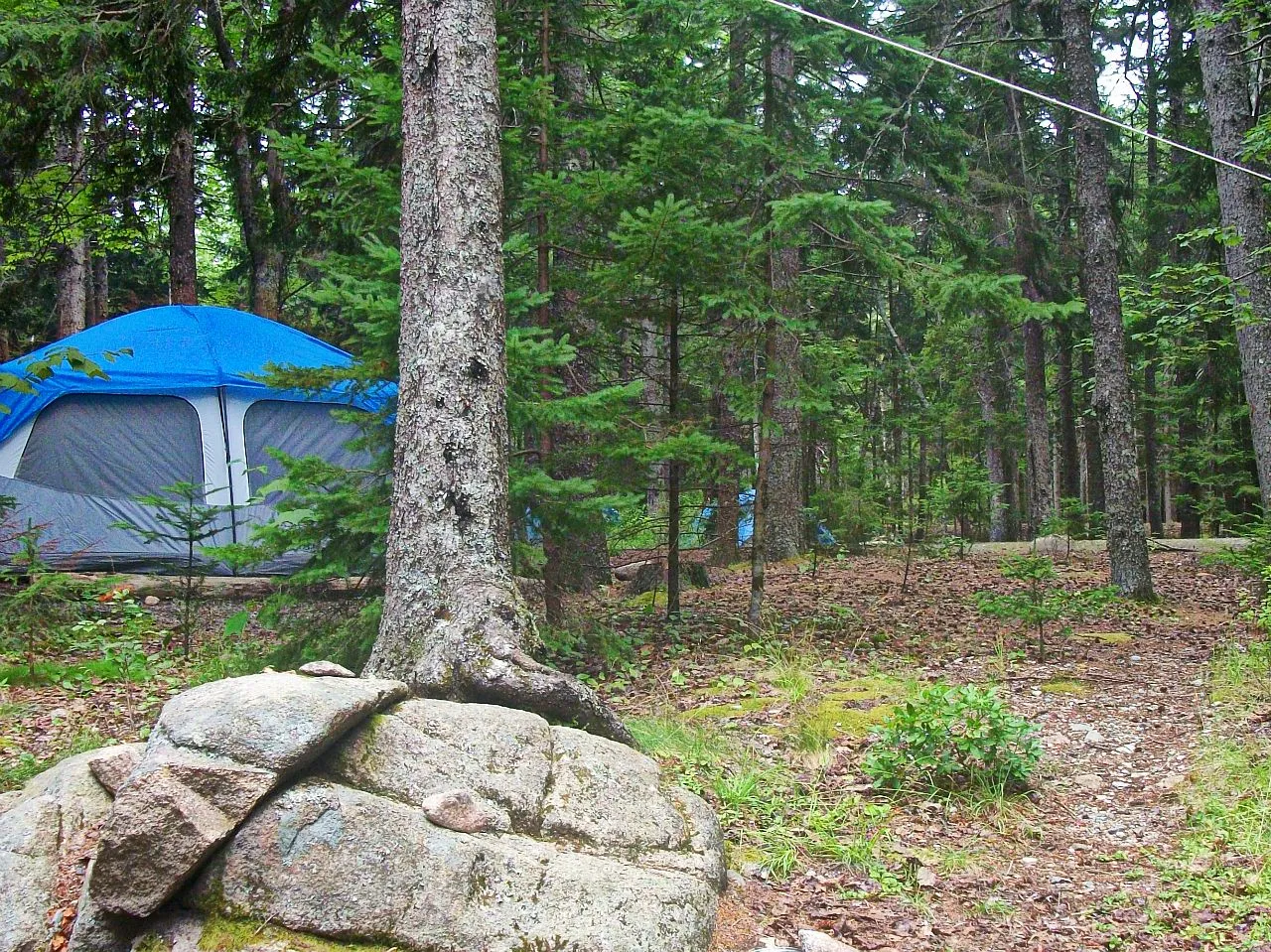







It gets dark early and dark hard in the Maine woods. There is no streetlight glow, no light pollution to soften the edges, so when the sun drops behind the spruce, you get a kind of dark that surprises people who only camp near towns. A headlamp gets you around, but a good lantern is what makes camp feel like camp: enough light to cook by, play cards, find the bug spray, and walk to the privy without tripping over a root.
The short version is that no single lantern does everything well. For a campsite you want bright, broad light, and the Goal Zero Lighthouse 600 covers it while also charging your phone. For inside the tent you want soft, low light, and a packable Goal Zero Crush Light or a magnetic Black Diamond Moji R+ is the better tool. If you want to flood a whole site the old-fashioned way, the Coleman propane lantern is brighter than anything battery-powered here. Most experienced campers carry two: one area light and one small tent light.
| Gear | Price | Best For | Type | Max Lumens |
|---|---|---|---|---|
| Premium | Campsite, charging phones | Rechargeable LED | 600 | |
| Premium | Ambient camp light | Rechargeable LED | 500 | |
| Mid-range | Packable tent light | Solar + USB LED | 60 | |
| Mid-range | Stick-anywhere tent light | Rechargeable LED | 200 | |
| Mid-range | Flooding a campsite | Propane | 1500 | |
| Lepro 1000LM | Budget | Bright budget all-rounder | Rechargeable LED | 1000 |
How Bright a Lantern Do You Actually Need?
Brightness is measured in lumens, and more is not always better. A campsite lantern that lights the picnic table and the cooking area wants something in the 300 to 600 lumen range, with the ability to dim down so you are not blinding everyone at the table. A tent lantern is the opposite. You want soft, low light, often under 100 lumens, because a bright light in a small tent is harsh and kills your night vision the second you step outside.
The propane Coleman sits in its own category at 1,500 lumens. That is genuinely a lot of light, enough to flood a group campsite, but it is also the only one here you cannot dim to a cozy glow and cannot bring inside. For most people the right answer is one mid-bright rechargeable lantern for the site and one small light for the tent, plus a headlamp on your forehead for everything else.
Warm light beats cool light at camp. A warm, slightly yellow LED around 2,700 to 3,500 Kelvin is easier on the eyes after dark, attracts fewer bugs than a harsh blue-white light, and just makes the site feel better. The lanterns here that let you choose a warm tone, like the BioLite AlpenGlow, are worth it for that alone.
The Camping Lanterns We Recommend
Goal Zero Lighthouse 600 - The Do-Everything Lantern
Premium
Goal Zero Lighthouse 600
Who it’s forA do-everything campsite lantern that also charges your phone
Why we picked it600 lumens lights a whole campsite, and dims way down for the tent
Pros
- Charges three ways, by USB, solar panel, or a built-in hand crank
- Doubles as a power bank with a 5,200 mAh battery and a USB-A out
Know before you buy
- Heavy and bulky for backpacking
- Only about 5 hours of runtime at the full 600 lumens
If you buy one lantern, this is the one to buy. The Lighthouse 600 puts out 600 lumens across a full 360 degrees, dims smoothly down to a tent-friendly glow, and can even light just one side so you point it where you need it. That alone makes it a strong campsite light. What sets it apart is everything else it does.
It charges three ways. Plug it into USB, clip on a Goal Zero solar panel, or, when both of those fail, spin the built-in hand crank, where a minute of cranking buys about ten minutes of light. The 5,200 mAh battery also works as a power bank with a USB-A output, so it tops off a phone, which matters in a state where you can drive an hour from the nearest outlet. On low it runs for days, and even on full blast it gives you about five hours.
The tradeoffs are size and weight. This is a car-camping and base-camp lantern, not something you carry on a long backpacking trip. And five hours at full 600 lumens is not long, though you will almost never run it that bright. For a campsite at Blackwoods or a power outage at home, it is hard to do better.
BioLite AlpenGlow 500 - Best for Ambient Light
Premium
BioLite AlpenGlow 500
Who it’s forAmbient camp lighting with a built-in power bank
Why we picked it500 lumens of warm, high-color light that makes camp feel good
Pros
- Big 6,400 mAh battery charges your phone with pass-through charging
- Color and dimming modes including a candle-flicker glow
Know before you buy
- Charges over the older micro-USB, not USB-C
- The shake-to-change-color gimmick is hit or miss
The AlpenGlow is the lantern you buy when you care how camp feels, not just how bright it is. It puts out 500 lumens of high-color-quality light, so colors look right instead of washed out, and it has a warm setting that makes a campsite feel cozy instead of clinical. It also runs a deep menu of color and effect modes, including a candle flicker that is genuinely nice on a quiet night.
Under the soft light is a serious battery. The 6,400 mAh cell runs the lantern for hours and works as a power bank with pass-through charging, meaning it can charge your phone while it is itself plugged in. It is rugged and rated IPX4, so a little rain or dew is no problem.
Two honest knocks. It charges over micro-USB rather than the newer USB-C, which is a minor annoyance if all your other cables have moved on. And the shake-to-change-color feature is more gimmick than tool and does not always work. Neither changes that this is the best mood-and-power lantern here for a relaxed camp.
Goal Zero Crush Light Chroma - Best Packable Light
Mid-range
Goal Zero Crush Light Chroma
Who it’s forAn ultralight packable light for the tent
Why we picked itCrushes flat to about half an inch for the pack or a tent pocket
Pros
- Built-in solar panel tops it off on multi-day trips
- Only 3.2 ounces, with color modes and a candle setting
Know before you buy
- Just 60 lumens, this is ambient light, not an area light
- Small battery and slow solar recharge
This is the one you actually carry into the backcountry. The Crush Light folds flat to about half an inch and weighs 3.2 ounces, so it disappears into a pack or a tent pocket and weighs nothing. Pop it open and it gives you a soft, lantern-shaped light with dimming, color modes, and a candle setting for the tent.
The clever part is the built-in solar panel on top. Leave it strapped to your pack during the day and it tops itself off, which means on a multi-day trip you are far less likely to end up with a dead light. It is the kind of small, smart piece of gear that justifies its spot in an ultralight kit.
Set your expectations on brightness. At 60 lumens this is ambient light, not an area light, and the small battery and slow solar charge mean it is a companion to a brighter lantern, not a replacement. As a tent and backpacking light, though, it is exactly right.
Black Diamond Moji R+ - Best Tent Light
Mid-range
Black Diamond Moji R+
Who it’s forA compact, stick-anywhere tent and table light
Why we picked itTiny puck that sticks to metal with built-in magnets
Pros
- 200 lumens, fully dimmable, plus color modes
- Rechargeable with an IPX4 rating for splashes and rain
Know before you buy
- Charges over micro-USB, not USB-C
- No power-bank output for your phone
The Moji R+ is a little puck of a lantern that solves the tent-lighting problem cleanly. It puts out a dimmable 200 lumens, runs full color modes, and, the best part, has magnets built in so it sticks to anything metal: a tent pole bracket, a cooler latch, the hood of your truck. Set it where you need the light and it just stays there.
It is rechargeable, IPX4 rated so light rain and splashes are fine, and it has a digital lock so it does not switch on and drain itself in your pack. The dimming goes low enough for a tent and bright enough to read by. It is small, it is tough, and it is one of the most consistently liked lanterns in this size class.
The limits are simple. It charges over micro-USB rather than USB-C, and it does not have a power-bank output, so it lights things but does not charge your phone. For a dedicated tent and table light, that is fine. It does its one job very well.
Coleman NorthStar - Brightest Campsite Light
Mid-range
Coleman NorthStar Propane Lantern
Who it’s forFlooding a whole campsite with light at a drive-in site
Why we picked it1,500 lumens is the brightest light here, it floods a campsite
Pros
- Push-button ignition lights it with no matches
- Runs on cheap propane canisters you can grab anywhere
Know before you buy
- Heavy, and it is an open flame, never for inside a tent
- Burns through propane and is loud when it lights
Sometimes you just want to flood the whole site with light, and nothing battery-powered here competes with propane for raw output. The Coleman NorthStar puts out 1,500 lumens off a single mantle, which lights a group campsite, a cooking area, and the card table all at once. The push-button ignition lights it without matches, and it runs on the same cheap propane canisters that feed your camp stove.
A propane canister runs the lantern for several hours, and you can find the fuel at any hardware store or gas station in Maine, which is part of the appeal. It is the classic, reliable camp lantern that has lit family campsites for generations.
Respect what it is, though. It is heavy, it runs on an open flame, and it gets hot, so it never goes inside a tent, full stop. It is loud when it ignites, with a pop some people find startling, and it burns through fuel you have to keep buying. For a stationary drive-in site where you want maximum light, it earns its place. For anything where you carry your gear, skip it.
Lepro 1000LM - Best Budget Lantern
Budget
Lepro 1000LM Rechargeable Lantern
Who it’s forA cheap, bright lantern that also charges a phone
Why we picked itBright 1,000 lumens for the price, with four light modes
Pros
- Charges over USB-C and doubles as a power bank
- Removable shade and dual hooks for hanging in a tent
Know before you buy
- Lower IP44 water rating than the premium lights
- Bulkier barrel shape that does not pack flat
The Lepro proves you do not have to spend much to get a bright, useful camp lantern. It cranks out up to 1,000 lumens across four modes, from a warm low glow to a full daylight blast, and it dims in between. For the money, that is a lot of light.
It charges over USB-C, which the pricier BioLite and Black Diamond lanterns oddly do not, and it doubles as a power bank off its 4,400 mAh battery, so it tops off a phone in a pinch. The shade comes off so you can hang it upside down inside a tent, and it has dual hooks for hanging it 360 degrees. As a cheap, bright, hang-anywhere lantern that also charges your phone, it covers a lot of ground.
The compromises show up in the details. It is rated IP44, which is splash-resistant but a step below the premium lights, so do not leave it out in a downpour. And the barrel shape does not collapse flat like the Crush Light, so it takes up more room. For a budget all-rounder, none of that is a dealbreaker.
Rechargeable, Solar, or Propane?
Rechargeable LED lanterns are what most people should buy now. They are bright, they dim, many double as power banks, and there is no fuel to buy or open flame to manage. The downside is you have to remember to charge them, and a dead battery in the backcountry is a dead lantern unless it has solar. That is where a solar-topped light like the Crush Light shines, literally, since it keeps itself alive on long trips.
Propane lanterns trade convenience for brightness and total independence from charging. They are the brightest option, they work in any weather, and you can always grab another canister, but they are heavy, hot, and never tent-safe. The honest answer for Maine is a rechargeable lantern for almost everything, with propane reserved for big family car-camping setups where the light needs to reach across the whole site.
Hang your lantern high, not on the table. Light coming from above your head lights the whole area evenly and keeps the glare out of everyone’s eyes. A lantern sitting flat on the picnic table blinds whoever is across from it and throws long shadows over the food. A tree branch, a tarp ridgeline, or a lantern hook does the job.
A quick note on power. In a state where cell coverage and outlets both run thin in the backcountry, a lantern that doubles as a power bank earns its keep. If keeping a phone alive for maps and photos matters to you, look hard at the Lighthouse 600, the AlpenGlow, and the Lepro, or carry a dedicated power bank alongside a simpler light.
Never run a fuel-burning lantern, propane or liquid, inside a tent or a closed vehicle. They consume oxygen and produce carbon monoxide, which is odorless and deadly. Battery and rechargeable LED lanterns are the only safe choice for inside a tent. This is not a small rule, people die from it every year.
What to Bring
- One brighter area lantern for the campsite (300 to 600 lumens, dimmable)
- One small, soft light for inside the tent
- A headlamp for each person for hands-free tasks
- Charging cables, or fuel canisters if you run propane
- Spare batteries or a power bank for the long trips
- A way to hang lights high (hook, cord, or carabiner)
- A warm-tone setting if your lantern has one, for fewer bugs and easier eyes
How many lumens do I need for a camping lantern?
For a campsite area light, 300 to 600 lumens is the sweet spot, bright enough to cook and play cards by but able to dim down so it is not harsh. For inside a tent you want much less, often under 100 lumens, because a bright light in a small space is uncomfortable and ruins your night vision. The 1,500-lumen propane Coleman is for flooding a large group site.
Are rechargeable or propane lanterns better for camping?
For most camping, rechargeable LED lanterns are the better choice. They dim, many work as power banks, and there is no fuel to buy or flame to manage. Propane lanterns are brighter and work without charging, which suits big family car-camping setups, but they are heavy, hot, and can never go inside a tent. Many campers keep a rechargeable lantern for everyday use and a propane one for large gatherings.
Can a camping lantern charge my phone?
Some can. The Goal Zero Lighthouse 600, BioLite AlpenGlow 500, and Lepro 1000LM all have built-in batteries with a USB output, so they double as power banks. This is genuinely useful in Maine, where you can be a long way from an outlet. If keeping a phone charged matters, choose a lantern with a power-bank feature or carry a separate power bank.
Is it safe to use a lantern inside a tent?
Only a battery or rechargeable LED lantern. Never use a propane, gas, or any fuel-burning lantern inside a tent or closed vehicle, because they burn oxygen and give off carbon monoxide, which is odorless and can be fatal. LED lanterns produce no fumes and run cool, so they are the only safe option for inside a tent.
Do I still need a headlamp if I have a lantern?
Yes. A lantern lights an area, but a headlamp lights wherever you look and keeps your hands free, which you need for tasks like hiking to the privy at night, fixing gear, or walking a trail after dark. Most campers carry both. The lantern stays at camp and the headlamp goes on your forehead. See our headlamp guide for picks.
How long will a rechargeable camping lantern last on one charge?
It depends entirely on the brightness. On low, lanterns like the Lighthouse 600 run for many days, even up to a couple of weeks. On full brightness, runtime drops sharply, often to just a few hours. In practice you rarely run a lantern at full output, so real-world battery life is much longer than the maximum-brightness number suggests.
A lantern is only part of your light setup. Pair it with a good headlamp for hands-free tasks, and if you camp off the grid, a power bank keeps both your lights and your phone alive through a long weekend.