











Every spring, from late May on, striped bass push up the Maine coast and park themselves at the rivermouths, beaches, and rock ledges from Kittery to Penobscot Bay. They are the biggest fish most Maine anglers will ever hook from shore, and chasing them requires no boat, no guide, and surprisingly little gear.
Here is the basic surf striper setup for Maine, the whole thing: a 9 foot medium-heavy spinning combo around the 6000 size spooled with 30 lb braid, a leader of 30 to 40 lb fluorocarbon or mono, and three lures, a swimming plug, a topwater, and a big soft plastic. If you fish bait, add the inline circle hooks that Maine law requires. That is the kit. Everything below is the specific version of each piece we would buy, and the rules you need to know before your first cast, because stripers are the most regulated fish on this coast.
We cover freshwater tackle in our Maine fishing gear guide and trout-water fly setups in the fly fishing guide. This page is all salt.
| Gear | Price | Best For | Type | Rating |
|---|---|---|---|---|
| Mid-range | Beaches, big water | Rod & Reel | 4.2 | |
| Budget | All-around plug | Swimming lure | 4.0 | |
| Budget | Surface strikes | Topwater lure | 4.6 | |
| Budget | Rocky shorelines | Soft plastic | 4.5 | |
| Budget | Bait fishing (required) | Hooks | 4.7 |
What Rod and Reel for Maine Stripers?
From a beach or a jetty, the standard answer is a 9 foot medium-heavy spinning rod with a reel in the 5000 to 6000 class. The length buys casting distance past the first bar and keeps your line above the breaking waves, and the reel size holds enough 30 lb braid to let a real fish run. From protected water, the rivermouths, harbor mouths, and tidal rivers where a lot of Maine striper fishing actually happens, you can drop to an 8 foot rod and fish lighter all day.
Salt is the other half of the answer. Striper gear lives in spray and sand, and reels with sealed, corrosion-resistant builds last seasons where bass-pond gear corrodes by August. Rinse everything in fresh water after every trip regardless. The combo below is the proven version of the surf approach.
PENN Battle Combo - Best Surf Setup
Mid-range
PENN Battle Spinning Combo 6000 with 9' Medium Heavy Rod
Who it’s forBest surf combo for Maine beaches and the Kennebec mouth
Why we picked itHT-100 carbon fiber drag handles a big striper's first run
Pros
- Full metal body and rotor shrugs off salt and sand seasons
- Braid-ready spool, no backing needed
- The 6000 size with the 9 foot rod is a real surf setup
Know before you buy
- All-metal build makes it heavier than graphite-bodied reels
- Overkill if you only fish protected rivermouths
The Battle is the combo we point people to when they are serious about beach fishing, because it is built like PENN expects you to dunk it. The reel has a full metal body, side plate, and rotor, so the gears stay aligned under the load of a big fish instead of flexing like a graphite body does, and the bail wire is heavy-duty aluminum. The drag is the headline: HT-100 carbon fiber washers, smooth from the first click, with more stopping power than any striper can use.
Details matter on the beach. The spool is braid-ready, so you tie 30 lb braid straight on with no mono backing, and the 5+1 stainless bearing system keeps the retrieve smooth after a season of salt spray. The rod is a graphite composite blank with aluminum oxide guides that handle braid without wear. Order it in the 6000 size with the 9 foot medium-heavy two-piece rod, that is the surf configuration, and the two-piece break-down rides inside a car instead of strapped to the roof.
The honest knock is weight. Full metal means the Battle is heavier in the hand than premium graphite-bodied reels, and a thousand casts into a long tide you will feel it. That is the price of a reel this durable at this money, and most surfcasters pay it gladly.
The Lures That Catch Maine Stripers
Stripers in Maine eat herring, mackerel, sand eels, and anything else that fits in their mouth, and three lure styles cover all of it.
Daiwa Salt Pro Minnow - The First Lure to Buy
Budget
Daiwa Salt Pro Minnow 6in Sinking
Who it’s forThe one lure to buy if you only buy one
Why we picked itThe swimming plug surfcasters reach for first
Pros
- Sinking 1 1/4 oz body casts far through wind
- Covers the water column from surface to bottom
- Catches schoolies and slot fish alike
Know before you buy
- Treble hooks complicate quick releases under slot rules
- Popular enough that it sells out in peak season
Ask ten Maine surfcasters to keep one lure and most keep this one. The Salt Pro Minnow is a 6 inch swimming plug that imitates the baitfish stripers are actually chasing, and the sinking version at 1 1/4 oz casts like a bullet through onshore wind that turns lighter plugs into kites. Count it down and it fishes the whole water column, listed depth runs from the surface to the bottom, which means one lure covers a boiling blitz and a dead-quiet tide.
Laser Shiner is the right first color, a flashy baitfish pattern for Maine’s clear water. The honest note for the slot-limit era: it carries treble hooks, and trebles plus a fish you are legally required to release is a knot worth thinking about. Crimp the barbs or swap in singles if you release most of your fish, and carry pliers either way.
Heddon Super Spook - The Topwater
Budget
Heddon Super Spook Topwater 3-Pack
Who it’s forBest topwater for explosive surface strikes
Why we picked itTopwater striper hits are the most exciting thing in Maine fishing
Pros
- Three proven colors, bone is the legend for a reason
- Walk-the-dog action calls fish up from deep water
- Saltwater-rated through hardware and finish
Know before you buy
- Trebles are rough on fish you have to release
- Mostly a dawn, dusk, and overcast game
Nothing in Maine fishing beats a striper detonating on a surface plug at first light. The Super Spook is the walk-the-dog topwater that the whole category copies, and this 3-pack covers the colors that matter: bone, the one striper anglers whisper about, plus baby bass and foxy shad. Heddon rates it for salt and fresh alike, and the listing is not shy about the intended customer, everything from largemouth to stripers to speckled trout.
Fish it on calm mornings, evenings, and overcast days, twitching the rod tip so the lure slashes side to side. The strikes will scare you. The trade-off is the same as the Daiwa: super sharp trebles are great at hooking fish and lousy at quick releases, so debarb or upgrade to inline singles if your fishing is mostly catch-and-release, which under Maine’s slot rules it mostly will be.
Lunker City Slug-Go - The New England Secret That Isn’t
Budget
Lunker City 9in Slug-Go (3 Pack)
Who it’s forBest soft bait for rocky shorelines and fussy fish
Why we picked itThe original soft stick bait, a New England invention
Pros
- Erratic dying-baitfish action stripers cannot leave alone
- Rigged weedless, it fishes rocky shore other lures cannot
- Works in fresh and salt, made in the USA
Know before you buy
- Soft plastic tears up after a few fish
- Three per bag goes fast when the bluefish show up
The Slug-Go is the original soft stick bait, born in New England waters and still made in the USA, and the 9 inch version is a striper staple from Connecticut to Downeast. Rigged on a big swimbait hook, it falls and darts with a wounded-baitfish wobble that the listing calls precision balanced and that stripers call dinner. Rigged weedless, it goes where your plugs cannot, through the rockweed and boulder fields that hold Maine fish.
It is also the quiet-water specialist. When fish are pushing bait in skinny water at dawn and ignoring hardware, a slowly twitched Slug-Go gets eaten. The downsides are built into soft plastic: a few fish, or one bluefish, will shred it, and three per bag disappears quickly. Buy two bags and a pack of 8/0-class swimbait hooks, and you are armed for the whole summer.
Gamakatsu Inline Circle Hooks - Required for Bait
Budget
Gamakatsu Octopus Circle Inline Hooks (7/0)
Who it’s forThe legally required hook for bait fishing Maine stripers
Why we picked itInline circle point meets Maine's bait-fishing rule
Pros
- Octopus shape holds bait well
- Circle design catches the jaw corner instead of the gut
- Sizes up to 7/0 suit chunk and worm fishing
Know before you buy
- Requires a reel-tight hookset instead of a swing
If you fish bait for stripers in Maine, chunks of mackerel, sea worms, live eels, the hook is not a preference, it is the law. Maine requires non-offset (inline) circle hooks whenever bait is used for striped bass, because circle hooks catch the corner of the jaw instead of the gut, and gut-hooked fish die even when released gently.
These Gamakatsus are the standard answer. The inline point meets the regulation, the octopus shape holds bait well, and the same listing carries a range of sizes up to 8/0. For chunk and worm fishing, 6/0 or 7/0 is the move, big baits and big mouths want big hooks. The technique change is the part nobody warns you about: do not swing when the rod loads up. Just reel tight and lift, and the circle does its job. Swing like a bass angler and you will pull the bait away from every fish.
Maine Striper Rules You Need to Know
Striped bass are tightly managed, the rules have real teeth, and they change, so check the Maine DMR site before your first trip each season. The 2026 rules in plain English, checked on September 30, 2026 against DMR’s 2026 striped bass regulations and its Chapter 42 rule:
The slot limit. You may keep one fish per day between 28 and 31 inches total length, measured from the lower jaw to the pinched tail. Everything under 28 and over 31 goes back, which means most of the fish you catch go back. The big breeders are protected on purpose.
Hook and line only, no gaffing. Landing a fish you might release means a net, a lip grip, or wet hands, never a gaff.
Circle hooks with bait, and treble limits. Ordinary bait fishing for stripers requires a non-offset (inline) circle hook, and “bait” is broad: any marine or freshwater organism, live or dead, whole or in parts, plus earthworms. Chapter 42 lists two narrow exceptions, a rubber or latex tube lure at least 8 inches long with a single hook at its end, and a willow leaf spinner rig with no more than two barbless hooks, and neither may carry a treble. Bait on treble hooks is illegal, full stop, and no artificial lure or fly may carry more than two treble hooks. A fish caught on the wrong hook type goes back immediately.
The Kennebec is its own rulebook. The Kennebec special area runs up to head of tide inside a line from Cape Small to Salter Island to Cape Newagen, which puts Popham Beach, Reid State Park, Merrymeeting Bay and the Sheepscot and Androscoggin rivers under its rules. It is closed to striper fishing from December 1 through April 30. From May 1 through June 30 it is catch-and-release only, with single-hooked artificial lures only (a single treble counts), and you may not use or possess bait there while fishing for any finfish, mackerel included. Harvest under the slot opens July 1 and runs through November 30. If your June plan is Popham, you are releasing every fish and throwing single-hook artificials only.
Closed water to know. Fishing for any species is closed within 150 feet of a dam that has a fishway, or of any part of a fishway, statewide. Federal waters, more than 3 miles from shore, are closed to striped bass entirely. On the Saco, the river upstream of the Route 9 (Main Street) bridge between Saco and Biddeford, up to the Cataract Dam, is closed to fishing.
Personal use only. Recreational stripers cannot be sold, and the fish must remain whole and intact.
Register first. Anglers 16 and older must sign up for Maine’s Saltwater Recreational Fishing Registry every year before fishing salt water, unless an exemption applies. It costs $1 online through DMR or $2 at a license agent. A valid Maine freshwater fishing license covers you, except a Lifetime License, and passengers on licensed charter or party boats are exempt; DMR lists the other exemptions.
Most stripers you catch will be released, so release them well. Keep fish in the water or on a wet surface, never on dry sand or rocks, support the belly for photos, and get them back fast. Maine DMR publishes catch-and-release guidance for stripers, and warm-water releases in August deserve extra care because stressed fish recover slowly in warm water.
Where to Fish for Stripers in Maine
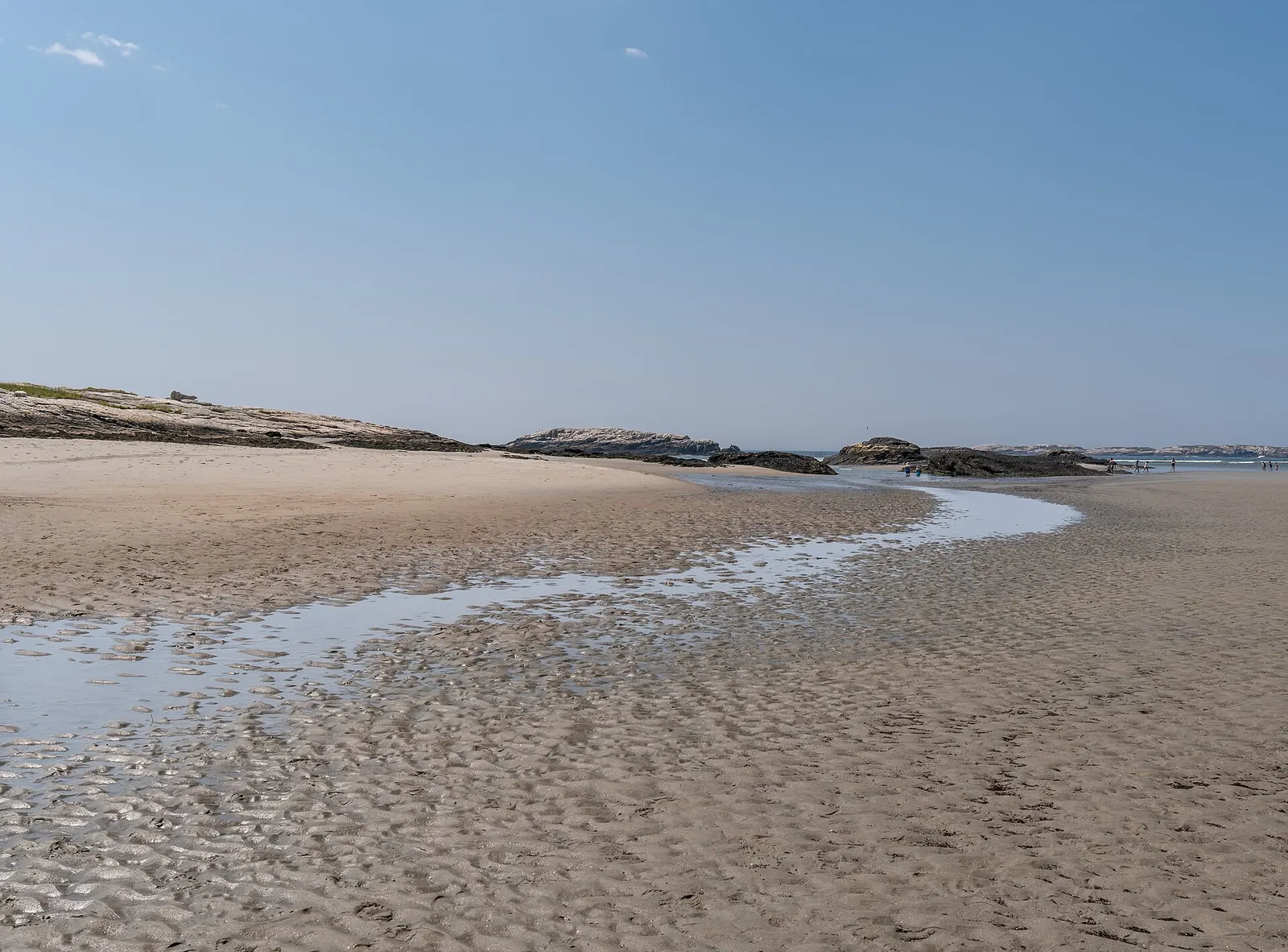
The short answer is moving water meeting the sea. The mouth of the Kennebec around Popham Beach is the most famous striper water in the state, with fish stacking along the bars and the river channel all summer, and the rocks at Fort Popham are a classic casting platform at moving tide. Just remember the special rules above: that whole stretch is closed December through April, catch-and-release with single-hook artificials only and no bait in your possession in May and June, and open to harvest from July 1. South of the Kennebec, the beaches and rivermouths from Ogunquit to Scarborough fish under the statewide rules (apart from the closed stretch of the Saco above the Route 9 bridge) and hold fish from late May on, and every tidal river in between has a town dock or a marsh edge that quietly produces.
Schoolies arrive first as the water warms in late spring, with bigger fish following into early summer. The fishing holds through September and into October, until the cooling water starts the fall migration back south. Maine Sea Grant reporting found Penobscot River stripers staying until October or November, so treat November as the tail end of the season. Tide beats time of day, fish the two hours either side of high water at a rivermouth and you will find them eventually, though first and last light stack the odds. Our Maine fishing guide covers the broader water-by-water picture, and paddlers chasing stripers should read our sea kayaking guide first, the Kennebec mouth current is no joke.
Walk Popham at dead low tide once before you ever fish it. The bars, holes, and channels that hold fish at high water are all visible at low, and twenty minutes of looking teaches you more than a season of blind casting. Bring the rod anyway. The channel edge fishes at every tide.
What to Bring
- Maine Saltwater Recreational Fishing Registry (register online with DMR before you fish)
- 9 ft medium-heavy combo spooled with 30 lb braid
- 3 to 4 ft leader of 30-40 lb fluorocarbon or mono
- Swimming plug, topwater, and 9 in soft plastics
- Inline circle hooks 6/0-7/0 if fishing bait (required by law)
- Pliers for unhooking, and a tape measure for the slot
- Headlamp for the dawn tide
- Wet hands or a rubber net for releases, never dry sand
- Current DMR striper regulations checked this season
What is a basic surf striper setup for Maine?
A 9 foot medium-heavy spinning rod with a 5000 to 6000 size saltwater reel, spooled with 30 lb braid and a 30 to 40 lb leader. Add a swimming plug like the Daiwa Salt Pro Minnow, a topwater like the Heddon Super Spook, and a 9 inch Slug-Go, plus inline circle hooks if you fish bait. That kit covers virtually all shore striper fishing in Maine.
What are the best lures for stripers in Maine?
Three styles cover it: a 6 inch swimming plug such as the Daiwa Salt Pro Minnow for all-around casting, a walk-the-dog topwater like the Super Spook in bone for dawn and dusk, and a 9 inch soft stick bait like the Slug-Go for rocky shorelines and pressured fish. Match the size of whatever bait the fish are pushing, and fish moving tide.
How big does a striper need to be to keep in Maine?
Maine's 2026 slot limit allows one fish per day between 28 and 31 inches total length, measured to the pinched tail. Fish under 28 inches and over 31 inches must be released, the fish must stay whole, and selling recreational catch is prohibited. Note that the Kennebec special area, including Popham Beach and Reid State Park, is closed December 1 through April 30 and catch-and-release only from May 1 through June 30, with harvest from July 1. Rules change between seasons, so confirm current regulations with Maine DMR before keeping anything.
Are circle hooks required for striped bass in Maine?
Yes, whenever you fish bait. Maine law requires a non-offset, inline-point circle hook for ordinary bait fishing for striped bass, because circle hooks lodge in the jaw instead of the gut and improve survival of released fish. DMR's Chapter 42 rule lists two narrow exceptions: a rubber or latex tube lure at least 8 inches long with a single hook at its end, and a willow leaf spinner rig with no more than two barbless hooks. Artificial lures may still carry trebles, with limits: no bait on treble hooks ever, no more than two trebles on any lure, and in the Kennebec special area's May and June season, single-hooked lures only.
When do stripers arrive in Maine?
The first schoolie-size fish show up along the southern Maine coast from late May as the water warms, larger fish follow into early summer, and fishing stays productive through September and into October before the fish head south. Early season concentrates at the rivermouths, and by midsummer fish spread along beaches, ledges, and tidal rivers up the coast.
Do I need a license to fish for stripers in Maine?
Anglers 16 and older must register every year with Maine's Saltwater Recreational Fishing Registry before fishing salt water, unless an exemption applies. It costs $1 online through Maine DMR or $2 at a license agent. A valid Maine freshwater fishing license covers you, except a Lifetime License, and DMR lists the other exemptions, such as passengers on licensed charter and party boats.